World War I tore apart the empires of Eastern Europe. Lines on maps shifted, armies marched, and millions of civilians were caught in between. For Jewish communities in Galicia, Bukovina, and the Russian Pale of Settlement, the war brought devastation and displacement. Many fled westward, seeking safety in the lands of the Austro-Hungarian Empire. One of those destinations was Slovenia, then part of the empire but a place rarely mentioned in refugee histories. This is the untold story of Jewish refugees in Slovenia during World War I.
During World War I, thousands of Jewish refugees from the Eastern Front passed through or settled in Slovenia, relying on local Jewish communities and humanitarian aid. Their journey was marked by danger, scarce resources, and bureaucratic hurdles. Today, their stories are being rediscovered through archival records and personal diaries, revealing a resilient chapter of Jewish survival in an unexpected corner of Europe.
The Great War and the Jewish Exodus
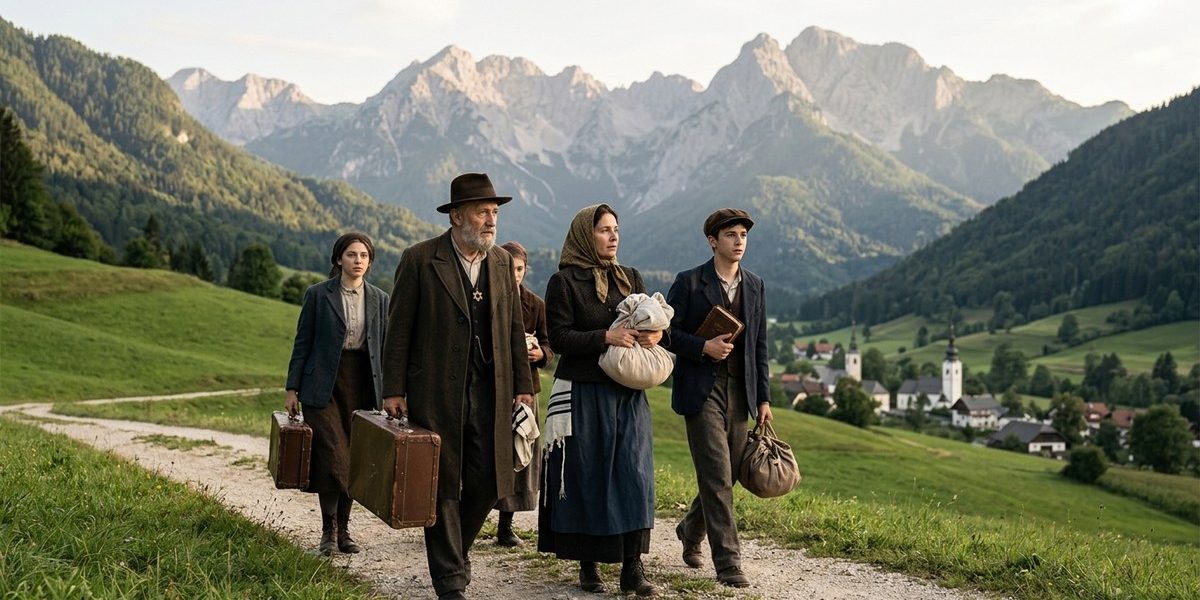
When Austria-Hungary declared war on Serbia in July 1914, it triggered a series of invasions and counteroffensives that ravaged the eastern provinces. The Russian army pushed into Galicia, burning towns and forcing entire Jewish populations to flee. By 1915, over 200,000 Jewish refugees had moved westward into the inner territories of the empire. Slovenia, with its mountain passes and relative distance from the front lines, became a natural corridor and temporary home.
Key groups affected included:
- Jewish residents of Lviv (then Lemberg) and surrounding villages who escaped the Russian occupation
- Communities from Bukovina who fled through the Carpathian passes
- Families from the borderlands of Hungary and Croatia who sought safer towns in Carniola and Styria
- Orphaned children sent ahead by parents who could not travel together
Slovenia as a Transit and Refuge Hub
Slovenian towns like Ljubljana, Maribor, Celje, and Ptuj saw a sudden influx of strangers. The local Jewish population, though small (barely 5,000 before the war), mobilized to help. Synagogues became soup kitchens. Private homes turned into shelters. The Austrian government established official refugee camps, but many refugees avoided them because of overcrowding and disease.
Here is how Jewish refugees found shelter in Slovenia:
- Local Jewish community networks – Jewish families in Maribor and Ljubljana opened their doors to relatives or coreligionists using prewar trade connections. The shared Yiddish language and religious practices made integration smoother.
- Charitable organizations – The Israelitische Allianz zu Wien and local branches of the Jewish National Fund sent food, clothing, and money. In Ljubljana, a refugee committee distributed relief parcels at the town hall.
- State-run camps and barracks – By 1916, the government set up refugee centers in former military barracks in Celje and Novo Mesto. Conditions were basic: straw mattresses, a daily bread ration, and shared washing facilities.
Many refugees did not stay long. Some moved on to Vienna or Trieste, hoping to reach relatives overseas. Others remained, working as peddlers or artisans, and a few settled permanently.
Daily Life and Hardships
The life of a Jewish refugee in Slovenia during World War I was one of constant uncertainty. They faced language barriers (most spoke Yiddish or German, not Slovenian), food shortages, and suspicion from local authorities who feared spies or troublemakers. Yet the diaries and letters that survive tell a story of resilience.
“We arrived in Ljubljana on a cold November night. The train had been stopped three times by patrols. A baker, a Jewish man from the city, took us in. He gave us soup and a place to sleep. That night, my mother cried for the first time in weeks. Not from sadness, but from relief.”
– Excerpt from the memoir of Miriam Goldstein, later deposited at the Jewish Historical Museum in Ljubljana.
One of the biggest challenges was disease. Typhus and dysentery swept through the crowded camps. A table of common misconceptions versus reality can help clarify the experience:
| Misconception | Reality |
|---|---|
| Refugees were welcomed by all locals | Many Slovenian peasants viewed them with distrust, and some resented the competition for food. |
| The Austrian government provided full support | Relief was inconsistent; refugees often relied on private charity to supplement meager rations. |
| All refugees quickly moved on | A significant number stayed for years, even after the war ended, due to destroyed homes and red tape. |
| The camps were well-organized | Overcrowding and lack of sanitation led to outbreaks of disease, especially in the winter of 1916–17. |
The Legacy and Memory
After the war ended in 1918, the new Kingdom of Serbs, Croats, and Slovenes (later Yugoslavia) inherited the refugee burden. Many Jews from the East applied for citizenship or temporary residence. Some succeeded, but others were repatriated or moved further west. The interwar period saw a small but vibrant community of former refugees and their children in Slovenia, especially in Maribor and Ljubljana.
Today, the stories of these Jewish refugees in Slovenia during World War I are being painstakingly pieced together by historians and archivists. Records at the National Archives of Slovenia in Ljubljana contain lists of refugee names, donation receipts, and letters. Personal photographs and diaries have been donated by descendants who live in Israel, the United States, and elsewhere.
For history enthusiasts or descendants seeking to trace their family history, the key is to look for these documents under the old administrative names of the Austro-Hungarian Empire. The town of Maribor, with its prewar Jewish quarter and its synagogue (now a cultural center), holds many clues. The Jewish cemetery in Ljubljana contains graves of refugees who died during the war.
To learn more about the broader canvas of Slovenian Jewish heritage, you can explore the hidden synagogues of medieval Ljubljana and the journey of Jewish merchants in Slovenian trade history. For those interested in later wartime experiences, the stories of Jewish partisan fighters in Slovenia during World War II offer a separate but connected narrative.
Honoring the Unseen Path
These Jewish refugees did not make headlines. They left no monuments. But their passage through Slovenia during the Great War is a reminder that even in times of chaos, ordinary people opened their doors and made room for strangers. The archives are slowly yielding their names, and with each document, another life is remembered.
If you are a researcher or a descendant, start with the lists. Look for the names of your family in the records of the Ljubljana refugee committee. Visit the local museums. And when you find a story, share it. Because history is not just about battles and treaties. It is about the people who survived, moved, and kept their traditions alive in a new land.