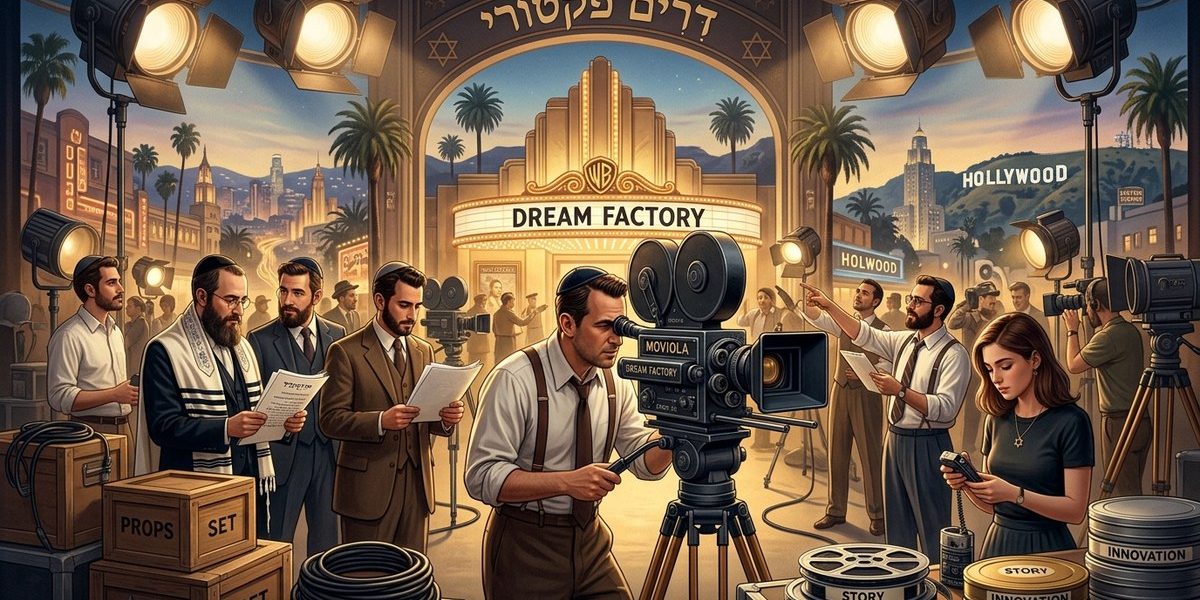
The glimmering lights of Hollywood owe a quiet debt to a group of young Jewish immigrants who arrived in America with little more than ambition and a deep love for storytelling. Between 1900 and 1930, a handful of mostly Yiddish-speaking men from Poland, Hungary, and the Pale of Settlement turned a sleepy citrus town into the global capital of entertainment. They didn’t just build studios; they built an industry that redefined American culture. Their journey from shtetl to screen is a story of resilience, reinvention, and the powerful role that Jewish values played in shaping the stories we still watch today.
The Hollywood studio system was created by a generation of Jewish immigrants who fled persecution and poverty. They turned their outsider perspective into a universal art form, embedding themes of family, justice, and the underdog into the DNA of American film. Understanding their roots helps us appreciate every movie we watch today.
From Shtetl to Studio: The Journey East to West
By the early 1900s, most major film studios were owned by first or second generation Jewish Americans. These men didn’t grow up in mansions. Carl Laemmle, founder of Universal Pictures, was born in a small German village and sold eggs before getting into the nickelodeon business. Adolph Zukor, who later ran Paramount Pictures, arrived from Hungary at sixteen with little money and no English. Louis B. Mayer started as a scrap metal dealer in Canada. William Fox began as a film distributor in New York after his family escaped Russian persecution.
Why did so many Jewish entrepreneurs flock to the movie business? The answer is partly practical and partly cultural. The film industry was new and unregulated, which meant there were no old guard restrictions against Jewish participation. In Europe, Jews were often barred from guilds and professions. In early Hollywood, the door was wide open. And because the initial audiences were working class immigrants themselves, Jewish filmmakers understood exactly what their viewers wanted: escape, emotion, and a happy ending.
The Big Five: Who They Were and What They Built
The major studios that dominated the Golden Age were all founded by Jewish immigrants or their children. Each brought a different personality and business philosophy to the table. The table below shows the key players and their contributions.
| Studio | Founder(s) | Year Founded | Signature Contribution |
|---|---|---|---|
| Universal Pictures | Carl Laemmle | 1912 | First studio to use star system and open sets to the public |
| Paramount Pictures | Adolph Zukor, Jesse L. Lasky | 1912 | Pioneered the “studio as factory” model with block booking |
| Metro-Goldwyn-Mayer (MGM) | Louis B. Mayer, Marcus Loew | 1924 | Created the most glamorous studio brand with “more stars than there are in heaven” |
| Warner Bros. | Harry, Albert, Sam, Jack Warner | 1923 | Introduced synchronized sound in “The Jazz Singer” |
| 20th Century Fox | William Fox (merged with 20th Century Pictures) | 1915 (as Fox Film) | Specialized in epic musicals and westerns |
These men didn’t just finance films. They built the infrastructure that turned movies into a dominant art form. They also created the star system, the studio backlot, and the distribution model that made Hollywood a global export.
How Jewish Values Shaped the Silver Screen
Even when they hid their Jewish identity behind Americanized names, these filmmakers infused their work with values drawn directly from their heritage. You can see it in the themes that repeat across their movies.
- Family above all. The idea of the loving, often chaotic family as the center of the world appears constantly. Think of the musical families in MGM’s “Meet Me in St. Louis” or the Warner Bros. social dramas.
- Justice for the underdog. Jewish filmmakers had experienced persecution firsthand. They made movies that rooted for the little guy, from Chaplin’s tramp to the courtroom hero in “Gentleman’s Agreement.”
- The outsider finding belonging. Stories about immigrants, farm girls moving to the city, or orphans discovering their worth all mirror the Jewish immigrant experience.
- Comedy as armor. The Lubitsch touch, the Marx Brothers’ chaos, and the wit of Billy Wilder all come from a tradition of using humor to survive hardship.
- Epic scope and spectacle. Many Jewish producers, especially Mayer and Selznick, believed cinema should inspire awe. “Gone with the Wind” and “The Wizard of Oz” weren’t just movies; they were grand statements of possibility.
“The Jewish contribution to Hollywood is not just that we built the studios. It’s that we brought a certain kind of moral earnestness along with a love for showmanship. We wanted audiences to leave the theater feeling better about life.” – Neal Gabler, author of An Empire of Their Own: How the Jews Invented Hollywood
Navigating Antisemitism While Selling Dreams
It’s easy to forget how much prejudice these men faced. In the 1920s, anti Jewish sentiment in America was widespread and overt. The film industry was often dismissed as a “Jewish business” in derogatory terms. Adolph Zukor was mocked as “the little Jew” by rival producers. The Hollywood elite formed exclusive clubs that barred Jewish members.
In response, Jewish filmmakers adopted a careful strategy. They hired powerful Christian front men to serve as studio figureheads. They avoided putting Jewish characters on screen unless they were heavily stereotyped. And they actively promoted assimilation. The most famous example is “The Jazz Singer” (1927), which tells the story of a Jewish cantor’s son who leaves his religious tradition to become a vaudeville star. The movie is at once a tribute to Jewish heritage and a plea for acceptance into mainstream America.
To combat antisemitism in the industry, studio heads created the Motion Picture Association of America (MPAA) in 1922, which allowed them to self regulate and deflect accusations of immoral content. They also supported organizations like the Anti Defamation League and the Jewish War Veterans. By the 1940s, many of them had become major philanthropists, funding Jewish hospitals, schools, and refugee relief.
Practical Steps: How to Research Jewish Filmmakers in Your Own Viewing
If you want to trace the fingerprints of these pioneers for yourself, you don’t need to travel to Los Angeles. Start with your local library or streaming service. Here’s a simple method to follow.
- Watch three films from each of the five key studios, focusing on their early output (1910s through 1940s). Look for themes of family, justice, and outsider identity.
- Read an in depth biography of one studio founder. I recommend The Merchant of Dreams: Louis B. Mayer, MGM, and the Secret Hollywood by Charles Higham.
- Visit a Jewish film festival or museum exhibit. Many cities hold screenings with historical commentary. The Academy Museum in Los Angeles also has permanent exhibits on the Jewish roots of Hollywood.
- Join an online discussion group. The Jewish Film Institute and the National Center for Jewish Film host virtual talks where historians unpack the cultural context.
- Take notes on recurring motifs. You’ll start to see patterns: the sacrifice for family, the tension between tradition and modernity, the dream of a better life. These are the stories that built the Dream Factory.
Jewish Filmmakers’ Lasting Legacy in 2026
Today, nearly a century later, the influence of those founding immigrants is still felt. Every time you watch a superhero save the day, a family quarrel resolved with a hug, or an underdog win against all odds, you’re seeing a story structure that Jewish filmmakers perfected. The industry they built survived the Great Depression, the blacklist, the rise of television, and the streaming revolution. And while the studio system has changed beyond recognition, the values those founders smuggled into American culture remain.
In 2026, new generations of Jewish filmmakers continue to draw on the same well. Directors like Noah Baumbach and Steven Spielberg (whose own grandparents fled Eastern Europe) keep the tradition alive. The annual Jewish Film Festival circuit grows every year. And scholars are finally giving the founders their due, recognizing that Hollywood is not just a place of glamour; it is a monument to immigrant ambition.
Next time you settle in to watch a classic film, take a moment to think about Carl Laemmle leaving his German village, or Louis B. Mayer dreaming in his scrap yard. They didn’t just make movies. They made a world where everyone could belong, even for two hours in a dark theater. That is a legacy worth celebrating.