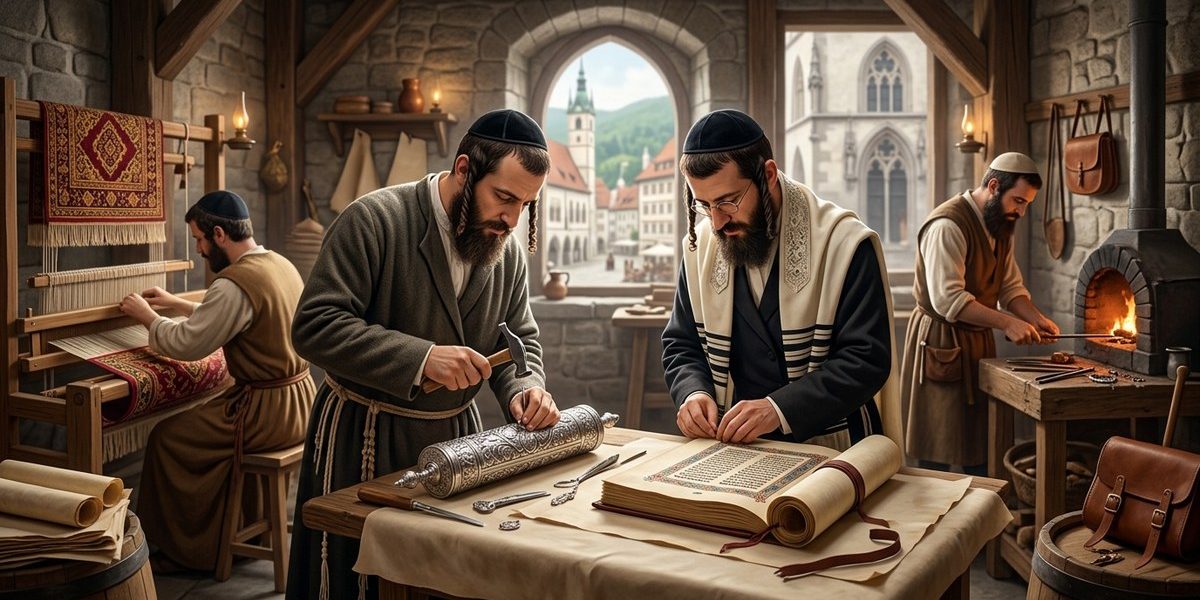
Medieval Slovenia was a crossroads of trade routes connecting the Adriatic to Central Europe. Caravans moved through mountain passes. Ships docked at Trieste. And in the towns of Ljubljana, Maribor, and Ptuj, Jewish artisans worked quietly behind their workshop doors. They were not just makers of goods. They were pillars of the local economy, bringing skills that Slovenian lords, bishops, and merchants could not find anywhere else.
Jewish artisans in medieval Slovenia were indispensable to regional prosperity. From glassblowing and metal casting to textile dyeing and money lending, they filled economic gaps that Christian guilds would not allow. Their technical mastery, trade networks, and unique legal status made them essential nodes in a web that stretched from Venice to Vienna. Without them, the medieval Slovenian economy would have looked very different.
The Economic Puzzle of Medieval Towns
Imagine a small medieval town like Ptuj in the 1300s. You have a castle on the hill, a church in the square, and a market day once a week. The local blacksmith makes horseshoes. The baker sells bread. But what happens when the local count wants a stained glass window for the new chapel? Or a noblewoman needs a fine gold necklace for her daughter’s wedding? Or a merchant wants to dye imported wool a deep crimson that does not fade?
This is where Jewish artisans became essential. Christian guilds strictly controlled most trades in medieval Slovenia. To become a master craftsman, you had to be a member of the guild. And to be a guild member, you had to be a Christian. Jewish craftsmen could not join these organizations. But they could work outside the guild system. They filled the gaps that the guilds left empty.
Jewish artisans brought specialized techniques from other parts of Europe. They had connections with Jewish communities in Venice, Vienna, and beyond. They could source materials and sell finished goods across borders with ease. For the local economy, this was a huge advantage.
The Artisan Trades That Built Prosperity
What exactly did these artisans make? The list is longer than most people realize.
Glassmaking was a prized skill. Jewish glassblowers in Maribor produced tableware, decorative pieces, and window glass. Their furnaces burned hot and steady. The glass they made was often clearer and stronger than what local competitors could manage. Some pieces traveled as far as the Hungarian royal court.
Metalwork included goldsmithing, silversmithing, and the casting of brass and bronze. Jewish metalsmiths were known for intricate filigree work on ceremonial objects. They made candlesticks, goblets, and belt buckles. They also repaired armor and weapons when local smiths were too busy or lacked the skill.
Textile dyeing was another key trade. Medieval Europe craved bright, lasting colors. Jewish dyers used plant-based mordants and imported indigo and madder. Their fabrics did not fade after a few washes. That made them popular with wealthy customers who could afford quality.
Bookbinding and manuscript illumination flourished in Jewish neighborhoods. Scribes copied Hebrew texts, but they also worked on Latin manuscripts for Christian patrons. Jewish bookbinders used leather tooling techniques that came from the Islamic world. Their books were works of art.
There were also Jewish tailors, cobblers, and tanners. They served both their own community and the wider population. But the most profitable trades were the ones that required rare materials or specialized knowledge.
The Financial Side: Money Lending and Trade Networks
Many Jewish artisans also acted as money lenders. This might seem unrelated to craft, but in practice the two roles reinforced each other. A Jewish goldsmith could accept a noble’s ring as collateral for a loan, then melt it down for materials if the debt went unpaid. A Jewish merchant could advance credit to a farmer for the next harvest, then sell the grain through his own trade network.
This financial role made Jewish artisans even more valuable to the medieval economy. Local rulers protected them because they needed access to credit. When the bishop of Ljubljana wanted to build a new cathedral tower, he borrowed from a Jewish lender. When a duke needed funds for a military campaign, he did the same.
But this also created tension. The Church officially discouraged Christians from lending money at interest. Jewish lenders faced no such religious restriction. They charged interest that was legal under local law. Over time, this earned resentment. Yet the economy could not function without them.
- A Jewish artisan would set up a workshop near the town’s main square or market.
- He would obtain raw materials through his own family or trade contacts in Venice.
- He would produce finished goods using techniques passed down through generations.
- He would sell those goods to local customers, traveling merchants, and nobles.
- He would also offer small loans and credit to regular clients, securing the debt against future work or property.
This cycle created wealth not just for the artisan, but for the entire town. The noble bought the sword and paid taxes. The merchant bought the cloth and resold it abroad. The farmer bought the plow blade and raised more crops.
What Medieval Records Tell Us
We have scraps of evidence. Tax registers from the 1300s in Maribor list Jewish households alongside their professions. Court records show disputes over unpaid debts and defective goods. Guild ordinances occasionally complain about Jewish competition. A parchment from 1385 in Ptuj records a Jewish glassmaker named Moshe who supplied the town council with drinking vessels for a feast.
“Item, to Moshe the Jew, for twelve glass cups with gilded rims, paid in silver denari, three marks.” — from a ledger book in the Ptuj municipal archives, 1385.
These records are rare but revealing. They show that Jewish artisans operated at a high level. They produced luxury goods for the elite. They were trusted with valuable materials. They had regular business relationships with Christian clients.
Some Jewish families became quite wealthy. They owned houses with workshops attached. They employed Christian journeymen and apprentices. They sent their children to study in yeshivas in Italy and Germany. Their economic success was visible, and that visibility had consequences.
The Fragile Balance of Tolerance
Medieval Slovenia was not a paradise of religious harmony. Anti-Jewish violence erupted at times. The most famous event is the 1515 expulsion of Jews from much of the territory. But for centuries before that, Jewish communities lived under a delicate arrangement. Local rulers granted them charters of protection. In exchange, the Jews paid special taxes and provided essential services.
The artisan’s role was central to this bargain. A Jewish community that produced valuable goods was worth protecting. A Jewish community that only lent money and collected debts was more vulnerable. The artisans gave the community a tangible economic purpose. They made the Jewish presence feel necessary rather than parasitic.
This is why towns like Maribor and Ptuj actively recruited Jewish settlers in the 1300s. They wanted the skills, the trade connections, and the capital. A Jewish glassmaker was worth more than a dozen peasant farmers.
The Crafts That Disappeared
After the expulsion of 1515, many Jewish artisans left Slovenia entirely. Some moved to Hungary or Poland. Others went to Italy or the Ottoman Empire. Their workshops closed. Their techniques faded from local memory.
The table below shows the main craft areas and what happened to them:
| Craft | Contribution to medieval economy | Impact of expulsion |
|---|---|---|
| Glassmaking | Produced tableware, window glass, and decorative objects | Lost entirely; no local artisans revived the techniques |
| Goldsmithing | Made jewelry, ceremonial items, and coinage | Partially survived through Christian goldsmiths, but quality declined |
| Textile dyeing | Produced colorfast fabrics using imported dyes | Dyeing knowledge persisted but became less sophisticated |
| Bookbinding | Bound manuscripts with leather tooling and gold leaf | Skills scattered; some continued in monasteries |
| Money lending | Provided credit to nobles, merchants, and farmers | Filled by other groups, but credit became harder to obtain |
The economic shock was real. Towns that had depended on Jewish artisans saw their craft sectors shrink. Maribor’s glass industry never recovered. Ljubljana’s luxury goods market contracted. It took decades for local Christian craftsmen to learn some of the lost techniques.
The Legacy in Modern Slovenia
Today, you can still see echoes of this history. In the Jewish quarter of Maribor, the old synagogue now serves as a museum. Inside, there are displays of medieval Jewish crafts. Reconstructed workbenches show how glass was blown and metal was cast. The Hidden Synagogues of Medieval Ljubljana also preserve the memory of these artisans.
Historians in 2026 continue to study these connections. They examine tax rolls, court cases, and trade agreements. They find that Jewish artisans were not a marginal group. They were central. They connected Slovenia to the wider Mediterranean economy. They brought innovation and quality. They created wealth for themselves and for their Christian neighbors.
- Jewish glassmakers introduced soda-lime glass that was more durable than local alternatives.
- Jewish metalsmiths used granulation and filigree techniques that had roots in ancient Israel.
- Jewish dyers knew how to fix color with alum, a mineral imported from the eastern Mediterranean.
- Jewish bookbinders used Islamic-style leather covers that caught the eye of collectors.
- Jewish money lenders financed everything from cathedral construction to peasant seed purchases.
Carrying the Story Forward
The story of Jewish artisans in medieval Slovenia is a reminder that economies are built by people, not by abstract forces. It was the skill of a glassblower in Ptuj, the steady hand of a goldsmith in Maribor, and the careful records of a lender in Ljubljana that kept the wheels turning.
If you are a history enthusiast or a student, there is still much to discover. Visit the museums. Read the old accounts. And next time you see a medieval glass cup in a collection, think about whose hands shaped it. It might have been made by a Jewish artisan whose name we will never know, but whose work changed the world around him.
For a deeper look at this world, you can read about How Jewish Traders Shaped Slovenia’s Medieval Economy. The artisans and the traders were part of the same ecosystem. They supported each other, and they made Slovenia a richer place in every sense of the word.
A Legacy Written in Silver and Stone
Jewish artisans did not just make objects. They made connections. They made markets. They made the medieval economy work better than it would have without them. The glass cups are broken. The gold necklaces are melted down or lost. But the pattern of skill, trade, and cultural exchange remains visible to anyone who looks.
The next time you walk through the old streets of Maribor or Ptuj, take a moment. Imagine the sound of a hammer on silver, the glow of a furnace, the smell of boiling dye. That was the sound of a community building its place in history. And that place mattered more than most people realize.