Classical music as we know it would not exist without the contributions of Jewish composers. For centuries, Jewish musicians faced barriers in European concert halls. Many were barred from teaching positions, denied access to conservatories, or forced to convert to have their work performed. Yet despite these obstacles, Jewish composers did not just participate in classical music. They reshaped it entirely. From the Romantic era through the 20th century, these artists brought new harmonic languages, emotional depth, and cultural fusion into the repertoire. Their stories are not just about survival. They are about transformation.
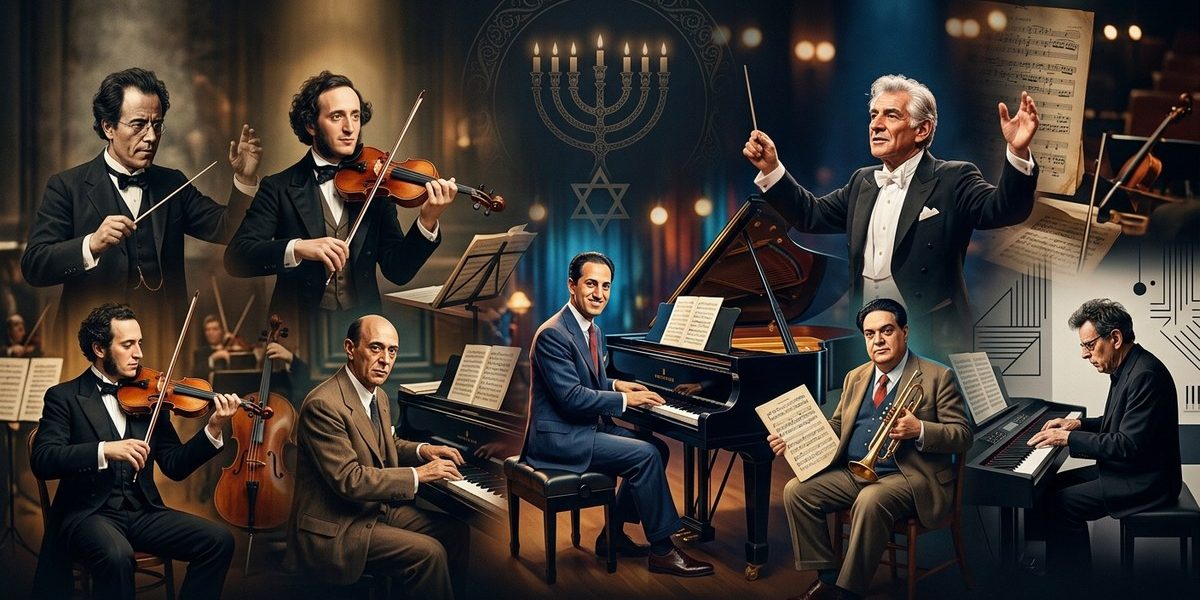
Jewish composers have shaped nearly every major movement in classical music over the past two centuries. From Mahler’s symphonic ambition to Gershwin’s jazz-classical fusion, these seven figures broke boundaries and expanded what orchestral music could express. Their Jewish identities informed their work in ways both subtle and direct, creating a legacy that resonates in concert halls worldwide in 2026.
The Roots of a Musical Revolution
Jewish musical tradition has always valued storytelling. The cantorial melodies of the synagogue, the modal scales of klezmer, and the rhythmic complexity of folk dances all fed into the classical tradition. When Jewish composers began writing for orchestras and opera houses, they carried these influences with them. They also carried a particular perspective. Many lived as outsiders in societies that both admired and resented them. That dual vision gave their music a unique emotional range.
The composers on this list represent different eras and styles. Some were explicitly Jewish in their identity. Others were secular or converted. But all of them drew on Jewish cultural memory in ways that changed classical music forever.
1. Felix Mendelssohn: The Romantic Revivalist
Felix Mendelssohn was born in 1809 into a prominent Jewish family that later converted to Lutheranism. His grandfather was the great Jewish philosopher Moses Mendelssohn. Despite the family’s conversion, Felix faced antisemitism throughout his career. The composer Richard Wagner later published a notorious essay attacking Mendelssohn specifically for his Jewish roots.
Mendelssohn’s music tells a different story. He revived interest in the works of Johann Sebastian Bach at a time when Bach was nearly forgotten. At age 20, Mendelssohn conducted the first performance of Bach’s St. Matthew Passion since the composer’s death. That single act changed music history.
Mendelssohn’s own compositions blend classical form with Romantic expression. His Violin Concerto in E minor remains one of the most performed works in the repertoire. His “Italian” Symphony captures the warmth of Southern Europe through a Northern European lens. And his incidental music for “A Midsummer Night’s Dream” includes the famous “Wedding March” still used in ceremonies today.
What makes Mendelssohn’s Jewish background relevant is not his religious practice. It is the perspective he brought as a cultural bridge. He synthesized German musical tradition with a broader European sensibility. That ability to move between worlds was a gift shaped by his family’s Jewish heritage.
2. Gustav Mahler: The Symphonic Visionary
Gustav Mahler once said, “I am thrice homeless: as a native of Bohemia in Austria, as an Austrian among Germans, and as a Jew throughout the world.” That sense of displacement fueled some of the most emotionally powerful symphonies ever written.
Mahler converted to Catholicism to secure the directorship of the Vienna Court Opera. But he never hid his Jewish origins. His music is filled with references that scholars now recognize as Jewish. The klezmer-inspired clarinet lines in his First Symphony. The ironic, dance-like passages that mimic the sound of Jewish folk musicians. The way his melodies stretch and bend like cantorial chant.
Mahler expanded the symphony to enormous proportions. His Eighth Symphony requires over 1,000 performers. But he also wrote intimate, heartbreaking songs. His “Kindertotenlieder” (Songs on the Death of Children) set poems about losing a child to music of devastating beauty. Tragically, Mahler’s own daughter died of scarlet fever shortly after he completed the work.
Mahler’s influence in 2026 is stronger than ever. Conductors like Leonard Bernstein (himself Jewish) championed Mahler when his music was out of fashion. Now Mahler’s symphonies are central to the orchestral canon. His Jewish identity gave his music a searching quality that speaks to audiences across cultures.
3. Arnold Schoenberg: The Twelve-Tone Revolutionary
Arnold Schoenberg fundamentally changed how music is composed. He developed the twelve-tone technique, which treats all twelve notes of the chromatic scale as equal. This broke centuries of tonal harmony based on major and minor keys.
Schoenberg was born into a Jewish family in Vienna. He converted to Lutheranism in his twenties but returned to Judaism in 1933. The rise of the Nazis forced him to flee Europe. He settled in Los Angeles, where he taught at UCLA and influenced a generation of American composers.
His Jewish identity became more explicit in his later works. He composed “A Survivor from Warsaw,” a powerful piece for narrator, chorus, and orchestra that describes the Warsaw Ghetto Uprising. The text includes the Shema Yisrael prayer. Schoenberg also worked on an opera about the biblical figure Moses, though he never completed it.
Schoenberg’s music is not easy listening. It demands attention and intellectual engagement. But his ideas opened doors that composers are still walking through in 2026. Film composers, jazz musicians, and experimental artists all draw on his innovations. His Jewish journey, from conversion to return, mirrors the complex relationship many Jewish artists had with their heritage.
4. George Gershwin: The American Original
George Gershwin grew up in a Yiddish-speaking household on the Lower East Side of New York. His parents were Jewish immigrants from Russia. Gershwin absorbed the sounds of the city: jazz from Harlem, Yiddish theater from Second Avenue, and classical music from the concert hall.
Gershwin blurred the lines between high and popular culture. His “Rhapsody in Blue” opened with a glissando on the clarinet that sounds like a jazz improvisation. But the piece is structured like a classical concerto. His opera “Porgy and Bess” combined Jewish musical theater traditions with African American spirituals and blues. The result was something entirely new.
Gershwin’s Jewish identity appears throughout his work. The opening of “Rhapsody in Blue” echoes the klezmer clarinet style. His Broadway shows used harmonic patterns common in Jewish prayer music. And his song “It Ain’t Necessarily So” from “Porgy and Bess” has a melody that sounds like a cantor improvising in synagogue.
Gershwin died young, at age 38, from a brain tumor. But his impact is immeasurable. He proved that classical music could be democratic, American, and Jewish all at once. His music remains among the most performed by orchestras today.
5. Leonard Bernstein: The American Maestro
Leonard Bernstein was the first American-born conductor to achieve international fame. He was also a composer, pianist, educator, and television personality. His Jewish identity was central to everything he did.
Bernstein’s parents were Jewish immigrants from Ukraine. He grew up in Boston and attended synagogue regularly. His bar mitzvah was a major family event. Throughout his career, Bernstein conducted works by Jewish composers with special insight. His recordings of Mahler are legendary. But he also championed Israeli music and supported Jewish cultural institutions.
His own compositions reflect his Jewish heritage. His Symphony No. 1, “Jeremiah,” uses text from the Book of Lamentations. His Symphony No. 3, “Kaddish,” sets the Jewish prayer for the dead. And his most famous work, “West Side Story,” adapts the story of Romeo and Juliet to the streets of New York. The score draws on Jewish musical traditions alongside Latin and jazz influences.
Bernstein believed music could heal divides. He conducted concerts for peace, taught young musicians on television, and spoke out against injustice. His Jewish values of tikkun olam, repairing the world, guided his work. In 2026, his legacy lives on through the Bernstein family foundation and countless performances of his music.
6. Ernest Bloch: The Voice of Jewish Spirit
Ernest Bloch made Jewish identity the explicit subject of his music. He was born in Switzerland in 1880 to a Jewish family. He studied in Brussels and Frankfurt before moving to the United States in 1916.
Bloch’s most famous work is “Schelomo,” a rhapsody for cello and orchestra based on the life of King Solomon. The piece uses modal melodies that echo Jewish liturgical music. The cello solo sounds like a voice pleading, arguing, and finally accepting divine will. It is one of the most moving works in the cello repertoire.
Bloch also composed “Avodath Hakodesh” (Sacred Service), a setting of the Jewish Friday night liturgy for chorus and orchestra. He called it “a Jewish Mass.” The work uses traditional Hebrew texts and melodies within a modern classical framework. It remains a staple of synagogue and concert hall performances.
Bloch taught at the Cleveland Institute of Music and the University of California, Berkeley. He influenced a generation of American composers. His commitment to Jewish musical expression paved the way for later composers to explore their heritage openly.
7. Steve Reich: The Minimalist Innovator
Steve Reich was born in 1936 to a Jewish family in New York. He is one of the most influential living composers in 2026. His music helped define minimalism, a style that uses repetitive patterns and gradual change.
Reich’s Jewish identity emerged later in his career. In the 1980s, he began exploring his Jewish roots. He composed “Tehillim,” a setting of Hebrew Psalms for voices and ensemble. The music uses the traditional cantillation of Jewish prayer but sets it within Reich’s signature minimalist style.
His most powerful Jewish work is “Different Trains.” The piece compares Reich’s childhood train journeys between New York and Los Angeles in the 1940s with the trains that carried European Jews to concentration camps. Reich uses recorded voices, train sounds, and string quartet to create a haunting meditation on memory and history.
Reich’s work shows that Jewish composers continue to innovate in the 21st century. His music is performed at major festivals and by leading orchestras worldwide. He proves that Jewish identity in music is not just about the past. It is a living tradition.
How Jewish Composers Changed Classical Music
Jewish composers classical music contributions can be understood through several key innovations. Here is a breakdown of what they brought to the tradition:
| Composer | Innovation | Jewish Influence |
|---|---|---|
| Mendelssohn | Revived Bach, Romantic lyricism | Cultural bridge between traditions |
| Mahler | Expanded symphony, emotional extremes | Klezmer melodies, outsider perspective |
| Schoenberg | Twelve-tone technique | Return to Judaism in later works |
| Gershwin | Jazz-classical fusion | Klezmer clarinet, Yiddish theater |
| Bernstein | American classical identity | Hebrew texts, tikkun olam values |
| Bloch | Explicit Jewish liturgical music | Biblical themes, Hebrew prayer settings |
| Reich | Minimalism, tape music | Hebrew Psalms, Holocaust memory |
Building Your Own Jewish Classical Music Playlist
If you want to start listening to Jewish composers classical music, here is a simple process:
- Start with Gershwin’s “Rhapsody in Blue.” It is accessible, joyful, and shows the fusion of Jewish and American styles.
- Move to Mahler’s Symphony No. 1. Listen for the klezmer-inspired third movement.
- Try Bloch’s “Schelomo.” Pay attention to how the cello sings like a human voice.
- Listen to Bernstein’s “West Side Story.” Notice the mix of Jewish, Latin, and jazz influences.
- Explore Reich’s “Tehillim.” Hear how ancient Hebrew prayer becomes modern music.
- End with Schoenberg’s “A Survivor from Warsaw.” It is challenging but deeply moving.
- Return to Mendelssohn’s Violin Concerto. Appreciate the elegance and emotional depth.
The Legacy Continues
Jewish composers classical music contributions did not end in the 20th century. Contemporary Jewish composers like John Zorn, Osvaldo Golijov, and Judd Greenstein continue to push boundaries. They draw on the same well of tradition: cantorial melody, klezmer rhythm, and the Jewish experience of being both inside and outside mainstream culture.
If you are a student or educator building a research project, start with the composers listed above. Their works are widely recorded and studied. If you are a music enthusiast creating a playlist, let these seven figures guide your listening. Each one opens a door into a different world of sound.
Jewish composers transformed classical music because they brought their whole selves to the art. They did not hide their heritage. They transformed it into sound. And that sound continues to move audiences in 2026.
For more on Jewish cultural contributions, read about how Jewish artists shaped modern art movements in Central Europe or explore the melodic legacy of traditional klezmer music and its Slovenian connections. You can also discover 5 influential Jewish writers who changed world literature or learn about what role Jewish intellectuals played in Slovenian academic life.