A single garment can hold the memory of a thousand-mile journey. Jewish folk costumes are not just beautiful pieces of cloth. They are living maps of where our ancestors came from, how they survived, and what they held sacred. When you look at a traditional Jewish outfit, you are looking at a story of migration and identity written in thread, color, and pattern.
Jewish folk costumes are portable archives of migration. Each region left its mark on the cut of a coat, the fold of a headscarf, or the stitch of an embroidered flower. By learning to read these details, educators and researchers can trace how Jewish communities adapted, preserved, and reinvented their identity across continents and centuries. These clothes are not relics; they are ongoing conversations between past and present.
What Jewish Folk Costumes Reveal About Migration Patterns
Jewish communities did not dress in a vacuum. Their clothing absorbed influences from the lands they passed through. A Jewish woman in 18th-century Poland wore a different head covering than her sister in Morocco. A man in Yemen tied his robe differently than a man in Lithuania. These differences are not random. They reflect the routes of trade, the pressures of local laws, and the desire to stay connected to a shared heritage.
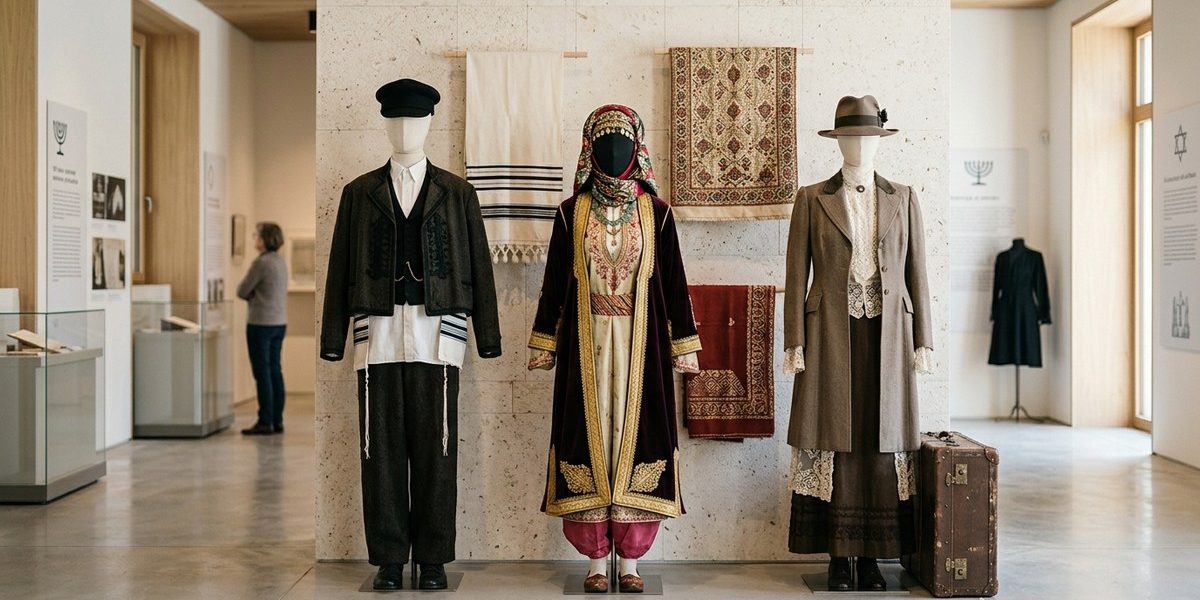
The most visible divide is between Ashkenazi and Sephardic traditions. Ashkenazi Jews, who lived in Central and Eastern Europe, often adopted local styles but modified them to meet religious needs. Sephardic Jews, who spread across the Ottoman Empire, North Africa, and the Balkans, blended Arabic, Berber, and Spanish influences into their dress. When families moved again, they carried those styles with them. A wedding dress from Bosnia might show traces of Ottoman silk weaving. A Sabbath coat from Galicia might echo the tailored coats of Polish nobility.
For researchers focused on Jewish folk costumes migration identity, examining these garments is like reading a diary written in cloth. The fabric does not lie.
The Language of Textiles: How Fabrics Traveled With Communities
Textiles were often the most valuable items a family owned. When Jews were expelled from Spain in 1492, they did not leave with empty hands. They took their silks, their linens, and their knowledge of weaving. Those materials ended up in the markets of Salonika, Istanbul, and Safed. Later, when Sephardic Jews moved to Slovenia and other parts of Central Europe, they brought threads that carried the sun of Andalusia and the patterns of the Ottoman court.
In Eastern Europe, Jewish tailors and seamstresses worked with locally available wool, linen, and flax. But they also traded for finer fabrics from Italy and France. The cost of a fabric could determine who wore what. Wealthy families could afford brocade and velvet. Poorer families used simpler weaves but compensated with intricate embroidery. That embroidery often told a story of its own. Flowers, birds, and geometric designs carried symbolic meanings. A pomegranate pattern meant fertility. A Star of David stitched into a sleeve protected the wearer.
To understand Jewish folk costumes migration identity, follow the thread. The thread never stays in one place.
Identity Stitched Into Everyday Wear
Costumes were not just for holidays. Everyday dress marked a person as Jewish in ways that outsiders could read. In many parts of Europe, sumptuary laws forced Jews to wear special badges or hats. But even without legal pressure, Jewish communities developed their own visual codes. A married woman covered her hair with a snood, a wig, or a kerchief. Men wore a kippah, a shtreimel (fur hat) on Shabbat, or a particular style of caftan.
These choices were about belonging. They said: I am part of this people. I follow these traditions. I remember where I came from.
At the same time, costume was a form of adaptation. Jewish tailors learned local techniques. They used the same scissors and needles as their Christian neighbors. But they also added their own touches. A Polish zupan (nobleman’s coat) became a Jewish bekishe when it was made without the forbidden mixture of wool and linen. A Turkish robe became a Sephardic kaftan when it was embroidered with Hebrew blessings.
This blend of adaptation and preservation is the heart of the story. Jewish folk costumes migration identity is not about either/or. It is about both. Both the new land and the old home. Both the local fashion and the ancient law.
A Step-by-Step Guide to Reading Costume Clues
If you are teaching a class or conducting research, you can use this method to decode any Jewish folk costume.
- Identify the garment type. Is it a coat, head covering, dress, or vest? Name it in the original language if possible (shtreimel, tallit, kippah, caftan, etc.).
- Look at the fabric. Is it wool, silk, cotton, or linen? The material tells you about climate, trade routes, and wealth. Wool suggests cold regions in Eastern Europe. Silk suggests warmth and access to Ottoman markets.
- Examine the decoration. Embroidery, lace, and trim are not random. Check for colors. Red often meant joy. Blue was protective. Gold signified wealth. Symbols like the hamsa or tree of life point to specific diasporas.
- Note the fastenings. Buttons, hooks, ties, or belts? The way a garment closes can reveal modesty practices or local tailoring traditions.
- Compare to local non-Jewish dress. What did Christian or Muslim neighbors wear? The differences and similarities show how Jews both blended in and stood apart.
By following these steps, you can start to see the migration story behind every stitch.
Costume Elements That Tell a Story
Certain parts of Jewish folk costume carry especially rich meaning. Here are a few for your study:
- Head coverings: From the Yemenite peaked hat to the Polish shpanyer hat, head coverings marked marital status, regional origin, and religious observance.
- Aprons: Jewish women in Eastern Europe wore embroidered aprons that often featured floral motifs. These were not just practical; they were a bride’s gift from her mother, carrying wishes for fertility.
- Vests: In many communities, men wore decorative vests over their shirts. The cuts and buttons signaled whether the wearer was Hasidic, Misnagdic, or Sephardic.
- Sashes: Wide woven sashes (such as the gartel) were worn during prayer. Their colors and patterns could indicate the region and the wearer’s teacher.
- Shoes and boots: In colder climates, boots were essential. The shape of the toe or the height of the heel sometimes followed local fashions but also had to allow for ritual washing.
Each element is a clue. Each clue connects to a specific place and time. When you study Jewish folk costumes migration identity, you are solving a puzzle that spans centuries.
Comparing Ashkenazi and Sephardic Costume Traditions
To clarify the differences, here is a table of common elements:
| Feature | Ashkenazi (Eastern Europe) | Sephardic (Balkans, North Africa, Ottoman) |
|---|---|---|
| Main fabric | Wool, linen, sometimes silk for the wealthy | Silk, cotton, brocade, light wools |
| Head covering (women) | Snood, wig, kerchief, often dark or embroidered | Headscarf wrapped high, often colorful with coins |
| Head covering (men) | Kippah, shtreimel (fur hat on Shabbat) | Kippah, fez, turban (depending on region) |
| Outer garment | Long caftan, bekishe, often black or dark | Long robe, often striped or patterned (kaftan) |
| Embroidery style | Dense floral and geometric, often with metallic thread | Delicate, colorful, influenced by Arabic and Spanish patterns |
| Holiday wear | White robes on Yom Kippur, special coats for Shabbat | Elaborate silk dresses, gold-embroidered vests |
This table makes it easy to see how climate, trade, and local culture shaped each tradition. But remember: Jewish communities moved. A Sephardic family that settled in Vienna might adopt some Ashkenazi elements. A Hasidic court in Jerusalem might wear fur hats that originated in Poland. Migration never stops, and neither does costume change.
The Role of Jewish Women in Preserving Costume Traditions
Jewish women were often the keepers of the needle. They sewed their families’ clothes, stitched trousseaus for daughters, and passed down patterns from mother to daughter. In many communities, a bride’s dowry included handmade garments that showed off her skill and her family’s traditions.
This was not just female labor. It was an act of resistance. When laws forced Jews into ghettos or forbade them from owning land, the knowledge of textiles and tailoring became a source of income and pride. Women could work from home, maintaining Jewish identity in the most intimate way: by clothing their loved ones.
One textile historian put it this way:
“A Jewish woman’s embroidery was her autobiography. She stitched the flowers of the fields she had left behind, the names of her children, and the prayers she hoped would protect them. The garment she made was a portable synagogue, a home altar, a declaration that she belonged to a people that could never be erased.”
That quote captures why Jewish folk costumes migration identity matters so deeply. The cloth is not just fabric. It is memory made visible.
How Slovenian Jewish Costumes Reflect a Unique Journey
Slovenian Jewish history is a story of small communities and repeated displacement. Jewish families lived in Maribor, Ljubljana, and Ptuj as early as the 13th century. They were expelled in 1515, returned gradually under the Habsburgs, and were nearly destroyed in the Holocaust. Each wave of migration left its mark on what they wore.
In the 19th century, Slovenian Jewish women dressed like their Catholic neighbors but added a telltale kerchief or an embroidered apron that revealed their heritage. Men often wore the long black coats typical of Central European Jews but paired them with local hats. After the revival of Jewish life in independent Slovenia since 1991, new generations have begun researching old photographs and asking: What did our great-grandmothers wear on Shabbat?
If you want to understand this local history better, you can learn how to celebrate Purim with costumes, hamantaschen, and joy in Slovenian Jewish tradition. Purim is a time when dressing up becomes an act of community memory. The costumes worn in Ljubljana’s synagogue today might mix old European styles with modern creativity. That blending is itself a migration story.
For deeper context on the visual heritage of the region, the article on uncovering the influence of Jewish artisans and crafts in Slovenian cultural heritage provides more examples of how material culture traveled with people.
A Living Tradition: What These Costumes Mean Today
Jewish folk costumes are not museum pieces. They are still made, worn, and adapted. In 2026, a young Jewish woman in Slovenia might sew a challah cover using a pattern her grandmother learned in Thessaloniki. A man attending a bar mitzvah in New York might wear a caftan inspired by Moroccan wedding robes. The identity lives in the cloth.
For educators and researchers, the lesson is clear. When you study Jewish folk costumes migration identity, you are not just looking at the past. You are seeing how people keep their roots alive while putting down new ones. Every stitch is a choice. Every color is a memory. And every garment, whether stored in a museum closet or worn at a family dinner, is a story waiting to be read.
So the next time you see a Jewish costume, let your eyes travel slowly. Start at the collar and work down. Notice the weave. Look for the hidden patterns. Ask yourself: Where did this thread come from? Whose hands touched it? And how did it end up here?
That is the story migration tells. That is the identity folk costumes preserve. And it is a story that continues to unfold, one garment at a time.