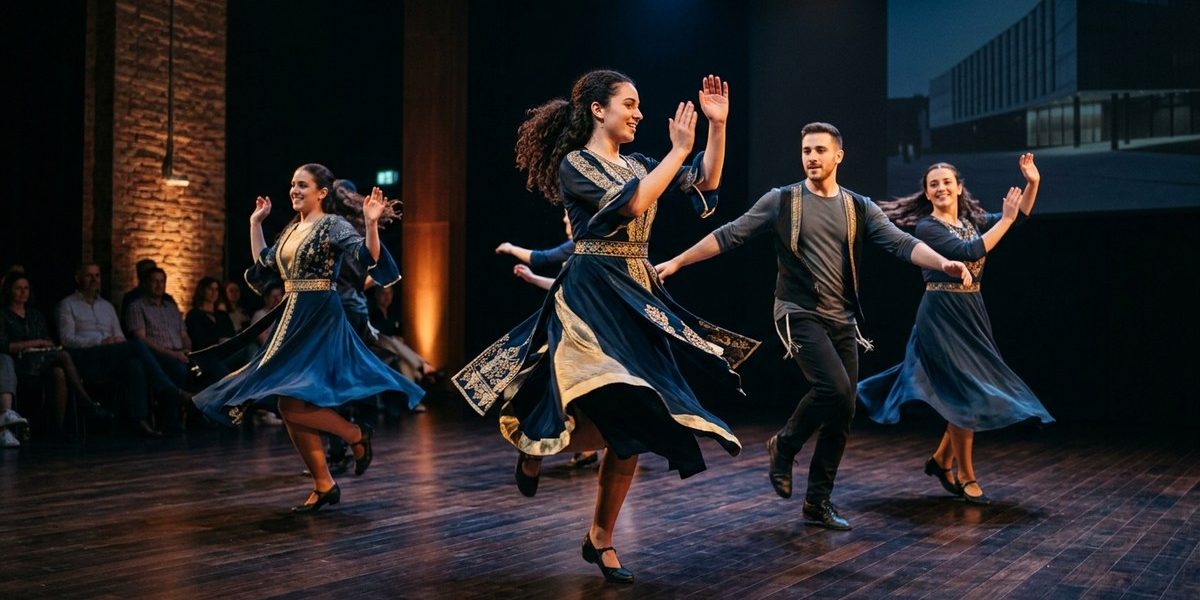
You might have seen a group of dancers lock arms and spin in a joyful circle at a wedding, laughing as the music pulls them faster and faster. That moment, the Hora, is more than a party move. It is a thread that connects centuries of Jewish communal expression to the stages of today. From the ecstatic leaps of Hasidic worship to the intricate footwork of Yemenite folk dance, Jewish movement traditions have quietly shaped how modern performers think about rhythm, storytelling, and connection. In 2026, as contemporary dance companies and experimental theater companies continue to borrow from these ancient forms, the influence is clearer than ever. Let us walk through the history, the key traditions, and the living legacy that keeps Jewish dance alive in modern performance art.
Jewish dance traditions are not static museum pieces. They are active, evolving tools that modern choreographers and performers use to explore identity, resistance, and joy. The Hora, Yemenite step, and Hasidic ecstatic movement each offer a distinct vocabulary that has influenced everything from Martha Graham’s work to 2026 street dance. Understanding this lineage helps you see modern performance with deeper cultural literacy. Appreciating the roots enriches your own creative practice or research.
The Living Roots of Jewish Dance
Jewish dance has never been a single, uniform style. It shifts with geography, culture, and religious practice. Ashkenazi traditions from Eastern Europe prized circular dances like the Hora, often danced at weddings and Simchat Torah celebrations. Sephardic and Mizrahi communities brought intricate hip movements and isolated upper body gestures, especially the Yemenite step, which alternates between a walking pattern and a quick, offbeat accent. Hasidic dance, with its ecstatic jumps and spins, reflects a spiritual desire to reach upward toward God.
These forms share common themes: community participation over solo spectacle, a connection to liturgical cycles, and an emphasis on the feet as carriers of memory. When you see a dancer today using grounded, stomping rhythms or spinning in a trance like state, you are watching echoes of these traditions.
How Jewish Dance Entered the Modern Stage
The early twentieth century saw Jewish immigrants bring their movement vocabulary to new lands, especially the United States. In New York City, dance schools and Yiddish theaters became laboratories for fusion. Jewish choreographers like Anna Sokolow and Helen Tamiris broke away from ballet, creating works that addressed social justice and psychological depth. Sokolow, trained at the Neighborhood Playhouse, drew on the angular, expressive gestures she saw in Jewish ritual dance.
Meanwhile, Martha Graham, though not Jewish herself, studied with Jewish dance pioneers and absorbed the weighty, earth bound quality of Jewish communal dance. Her famous contraction and release technique mirrors the percussive, breath driven movements found in Yemenite and Middle Eastern Jewish dances. The modern dance revolution of the 1930s and 1940s was deeply indebted to these cultural exchanges.
Key Traditions That Still Resonate
Let us look at three Jewish dance traditions that have a direct line into 2026 performance art.
The Hora
The Hora is a circle dance, often done at celebrations. Dancers hold hands or link arms and move in a clockwise circle, with steps that vary from a simple grapevine to a fast running step. The power of the Hora is its communal nature: no one leads, everyone participates. Modern choreographers like Ohad Naharin, founder of Batsheva Dance Company, have used circle formations to explore themes of unity and loss. In the 2026 hit dance piece “Circle of Salt”, the Hora structure is used to tell a story of exile and return.
The Yemenite Step
This step is a hallmark of Israeli folk dance. It consists of a step forward, a step back, and a shift of weight. Its syncopated rhythm creates a sense of forward flow and sudden hesitation. Contemporary choreographers love it for its emotional ambiguity: it can feel both joyful and tense. In 2026, the step appears in many commercial dance routines, from music videos to Broadway shows like “The Garden of Broken Glass”.
Hasidic Ecstatic Movement
Hasidic dance is characterized by vigorous, repetitive movements, often involving jumping, stamping, and spinning. The goal is to reach a state of spiritual ecstasy. Modern performance artists have borrowed this vocabulary to represent altered states, protest, or liberation. The 2025 performance “Unbound” at the Jewish Community Center in New York used Hasidic style spinning to represent the experience of refugees.
A Practical Guide: Tracing Jewish Dance Influence in a Performance
If you are a student or researcher trying to identify Jewish dance influence in a modern work, here is a simple process.
- Watch the feet. Jewish dance often emphasizes grounded footwork, with small, precise steps or stomps. Look for patterns like the Yemenite step or the Hora grapevine.
- Notice the formation. Circles, lines, and chains are common. If dancers are linked together, it likely draws from communal Jewish dance.
- Check the emotional arc. Jewish dance traditions often move from restraint to release, or from grief to joy. This emotional journey is a hallmark of works inspired by Jewish liturgical dance.
- Research the choreographer. Many contemporary choreographers with Jewish heritage, like Ohad Naharin, Hofesh Shechter, or Crystal Pite, openly cite Jewish dance as an influence. Read interviews and program notes.
- Listen for the music. Klezmer, Israeli folk, and Mizrahi rhythms often accompany these dances. If the score uses irregular time signatures or a driving, repetitive beat, you may be hearing Jewish musical traditions that influence the movement.
Elements That Cross Over
Here are the key elements of Jewish dance that appear in modern performance art.
- Circular or chain formations that emphasize community.
- Syncopated, offbeat rhythms in the footwork.
- A mix of grounded, heavy steps and sudden, light jumps.
- Use of the upper body in isolation, especially in Sephardic influenced styles.
- Repetitive, trance like sequences that build emotional intensity.
- Gestures that mimic everyday Jewish rituals, like lighting candles or blessing bread.
Traditional vs. Contemporary Applications
The table below shows how traditional Jewish dance elements are adapted in modern performance.
| Traditional Element | Original Context | Modern Usage | Common Mistakes in Adaptation |
|---|---|---|---|
| Hora circle | Wedding and festival celebration | Used in ensemble works to symbolize unity, diaspora, or cyclical time | Making it too neat and choreographed instead of allowing spontaneous community interaction |
| Yemenite step | Folk dance step | Adds rhythmic interest and emotional tension in contemporary pieces | Overusing it without varying the intention; it becomes a gimmick rather than a meaningful gesture |
| Hasidic spinning | Ecstatic prayer and worship | Represents altered states, spiritual seeking, or political protest | Performing it without the emotional investment; spinning becomes a trick instead of a spiritual practice |
| Stomping footwork | Simchat Torah, wedding processions | Creates percussive sound and a sense of grounding or protest | Stomping too hard and losing musicality; the footwork should be crisp but not violent |
| Hand gestures (kohanic blessing) | Priestly blessing in synagogue | Used to evoke ritual authority or blessing in performance | Using them out of context without understanding the sacred meaning, which can feel disrespectful |
“Jewish dance is not about perfect lines or high lifts. It is about the breath between steps, the weight of the foot on the earth, and the way a circle can hold both joy and sorrow. When I choreograph, I always go back to those simple ideas. They are a library of human emotion.”
* Avigail Malachi, choreographer and artistic director of the Jewish Dance Project, 2026
Preserving and Evolving the Legacy
Jewish dance influence continues to grow. In 2026, we see it in hip hop battles where dancers incorporate the Yemenite step. We see it in contemporary ballet companies like the Alvin Ailey American Dance Theater, which includes works by Jewish choreographers that draw on these roots. Even in virtual reality performance art, the circular formations of the Hora are being used to create immersive communal experiences online.
For the performing arts enthusiast, understanding this influence means you can watch a piece and recognize the layers. You see not just movement, but memory. You see centuries of migration, prayer, and celebration compressed into a single gesture.
If you are a student writing a thesis or a dancer building a piece, start by learning one Jewish dance form well. Attend a community Hora. Learn the basic Yemenite step from an online tutorial. Read about the history of Jewish dance in the diaspora. The deeper you go, the more you will see its fingerprints everywhere.
The Rhythm of Continuity
Jewish dance traditions are not a closed chapter. They are a living, breathing vocabulary that modern performance artists continue to remix. From the ecstatic spin of a Hasidic dancer to the grounded circle of a wedding Hora, these movements carry stories of resilience, faith, and joy. In 2026, as performance art becomes more global and more hybrid, Jewish dance influence offers a steady pulse. It reminds us that the body is a vessel for memory, and that the simplest step can hold the weight of generations.
So next time you see a dancer spin, or a line of performers lock arms and move in a circle, pause. That is not just choreography. That is a tradition bending forward into the future. Let it move you, and then maybe let it move you to learn a step yourself. The dance floor is open.