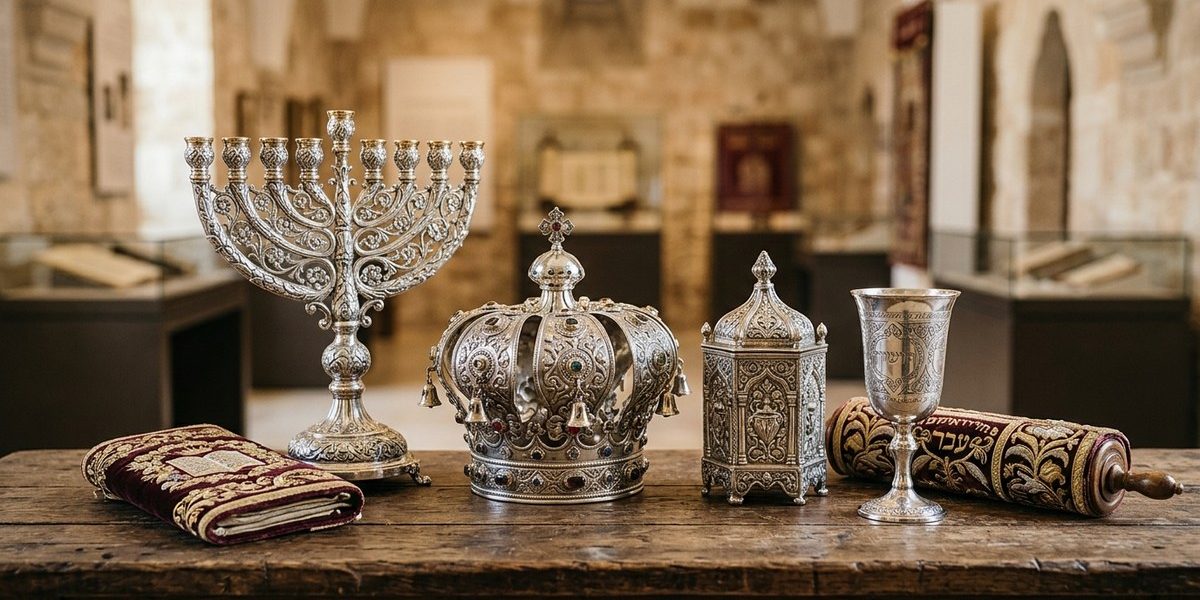
A silver Kiddush cup catches the candlelight on a Friday evening. The filigree work on a Torah crown gleams as the scroll is lifted. These objects do more than hold wine or adorn parchment. They carry memory, faith, and centuries of artistic mastery. Jewish ceremonial art transforms everyday rituals into moments of sacred beauty. For the curious visitor, museum goer, or student, each piece offers a window into a tradition that has always valued hiddur mitzvah: the duty to beautify a commandment.
Jewish ceremonial art is not just decoration. It is a living record of Jewish communities across time and place. From the silversmiths of Renaissance Italy to modern artists in Slovenia, these objects reflect local styles, religious laws, and deep devotion. Understanding their materials, symbols, and makers helps us see how faith and art became one.
What Makes an Object Ceremonial?
A ritual object is any item used during a Jewish observance. It can be a Shabbat candlestick, a spice box for Havdalah, a mezuzah case, or an etrog box for Sukkot. What sets Jewish ceremonial art apart is the combination of function and symbolism. The object must be usable according to halakha (Jewish law), but it should also be beautiful. This idea of hiddur mitzvah has driven artists for centuries.
Jewish ceremonial art is not a single style. Because Jewish communities lived in many places, they adopted local artistic traditions. A Torah shield from 18th century Poland looks different from one made in 1920s Morocco. The common thread is the purpose: to honor God and elevate the ritual.
The Core Objects of Jewish Ceremonial Art
Here are the most important categories of ritual objects you will encounter. Each one has a long history of artistic development.
- Kiddush cups – Used for blessing wine on Shabbat and holidays. Often made from silver, sometimes with intricate engraving or enamel.
- Hanukkah menorahs (hanukkiot) – Nine-branched candelabras. Styles range from simple brass to elaborate filigree.
- Torah ornaments – Includes the Torah crown (Keter), finials (Rimonim), shield (Tas), and pointer (Yad). Usually silver, often gilded.
- Spice boxes (besamim) – Used in Havdalah ceremony. Shapes vary: towers, fruits, animals.
- Mezuzah cases – Hold the parchment scroll on doorposts. Made from wood, metal, glass, or ceramic.
- Etrog boxes – Decorative containers for the citron used on Sukkot. Often silver or carved wood.
- Seder plates – Used at Passover. Usually tiered or with designated spots for symbolic foods.
- Kiddush goblets and candlesticks – Essential for Shabbat home rituals.
How Jewish Ceremonial Art Changed Over Time
From Ancient to Medieval
The earliest Jewish ceremonial art came from the Temple in Jerusalem. After the destruction, communities created objects for synagogue and home. During the Middle Ages, Jewish silversmiths in Spain, Germany, and Italy produced some of the finest work. They blended Gothic, Moorish, and Renaissance motifs with Jewish symbols like the menorah, Star of David, and lions of Judah.
The Influence of Local Craftsmanship
Wherever Jews settled, they absorbed local techniques. In Eastern Europe, artisans carved wooden Torah arks and painted intricate murals. In North Africa, metalworkers used filigree and enamel. In Slovenia, Jewish ceremonial objects show Central European baroque and rococo influences, as seen in surviving synagogue silver. This cross cultural exchange is part of what makes the art so rich.
Modern and Contemporary Revival
The 20th century brought new materials and ideas. Artists like Ludwig Wolpert and Moshe Zabari used modernist forms in silver. Today, contemporary Jewish artists work in glass, steel, and even recycled materials. The revival of interest in Jewish ceremonial art has also led to new designs for home rituals, making tradition feel fresh.
Materials That Tell a Story
The choice of material often reflects both practicality and symbolism. Silver is the most common metal for synagogue objects because it is durable, precious, and does not rust. Gold was used for Torah crowns, but only in wealthy communities. Wood and brass were more accessible for home objects.
| Material | Common Uses | Symbolism |
|---|---|---|
| Silver | Torah ornaments, Kiddush cups, spice boxes | Purity, durability, sacrificial tradition |
| Gold | Torah crowns, priestly breastplate replicas | Divine light, royal status |
| Wood | Torah arks, mezuzah cases, etrog boxes | Connection to nature, humility |
| Glass | Menorahs, seder plates | Fragility, clarity, light |
| Brass | Home menorahs, candlesticks | Affordability, warmth |
How to Identify Authentic Jewish Ceremonial Art
If you are visiting a museum or antique shop, here are three steps to help you understand what you are seeing.
- Look for hallmarks and inscriptions. Many objects have a maker’s mark, city stamp, or date. Hebrew inscriptions often name the donor or the occasion. A dedication like “In memory of my mother” tells you it was made for a specific community.
- Examine the style against local history. A Hanukkah menorah with floral repoussé work likely came from 19th century Germany. A minimalist silver Kiddush cup from the 1950s might be by an Israeli artist. Compare the design with known regional schools.
- Check for signs of use. Scratches on a Kiddush cup or wear on a Torah pointer indicate it was actually used in ceremonies, not just display. Patina and dents add historical value.
The Modern Makers Keeping the Tradition Alive
Today, many artists continue the practice of creating Jewish ceremonial art. In Slovenia, contemporary silversmiths and jewelers are rediscovering historical forms and adding their own twist. The work of these artisans is part of a broader story. To understand how Jewish artists shaped larger movements, you can read about how Jewish artists shaped modern art movements in Central Europe.
Similarly, the tradition of Jewish calligraphy and illuminated manuscripts overlaps with ceremonial object making. Many Torah pointers and crowns are designed to match the aesthetic of the scroll they accompany. For a deeper look at this, see how Jewish calligraphy and illuminated manuscripts reflect centuries of devotion.
“The best Jewish ceremonial art feels both timeless and specific to its moment. You can see the hand of the maker and the soul of the community.” – Dr. Ruth Ellen Gruber, author and scholar of Jewish cultural heritage.
Common Misconceptions About Jewish Ceremonial Art
Some people think Jewish art cannot contain figurative images because of the second commandment. In reality, Jewish law prohibits only idolatry. Throughout history, Jewish artists have included human and animal figures in manuscripts, synagogue mosaics, and even on Torah crowns. The prohibition is against making images for worship, not against art itself.
Another misunderstanding is that all Jewish ceremonial objects are old. In fact, new objects are created every year. Families commission modern Kiddush cups for weddings, and synagogues commission contemporary Torah arks. The tradition is alive.
Why the Craftsmanship Matters Today
In 2026, interest in handmade objects is growing. People want things with meaning, not mass produced decor. Jewish ceremonial art offers that meaning in a direct way. It connects the maker, the user, and generations of tradition. When you hold a silver spice box that was crafted in Ljubljana in the 1800s, or a modern glass menorah by a Slovenian artist, you touch history.
This art also teaches us about migration and adaptation. The same ritual object looks different in Venice, Istanbul, and New York. That variety is not a flaw. It is a sign of life. Each community made the object its own while keeping the core purpose intact.
How You Can Appreciate Jewish Ceremonial Art
Here are some practical tips for engaging with these objects, whether you are a collector, a student, or just curious.
- Visit local Jewish museums or cultural centers. Many have rotating exhibits of ceremonial silver.
- Notice the details. Look for the artist’s initials, the type of engraving, and the wear patterns.
- Read about the communities that made them. For example, the Jewish community in Slovenia thrived through centuries of change and left behind beautiful ritual objects.
- Attend an interfaith Seder or Hanukkah celebration to see these objects in use.
- Consider commissioning a piece for your own home. Many contemporary artists create custom mezuzah cases or Kiddush cups.
The Stories Hidden in Silver and Gold
Each object holds a story. A Kiddush cup passed down from a grandmother in Poland. A Torah shield donated by a merchant in Trieste. A spice box shaped like a tower that still holds cloves. These objects survived persecution, war, and relocation. They are not just artifacts. They are witnesses.
The next time you see a piece of Jewish ceremonial art, take a moment. Think about the hands that made it, the families who used it, and the faith that inspired it. That connection is what makes this art so powerful. It is beauty with purpose.
Where to Go Next
If this topic has sparked your interest, there is much more to discover. You can learn about the hidden synagogues of medieval Ljubljana and the architecture that housed these objects. Or read about how Jewish dance traditions continue to shape modern performance art for another facet of artistic expression.
Jewish ceremonial art is a doorway into a rich cultural world. Step through it. You will find centuries of mastery, devotion, and beauty waiting for you.