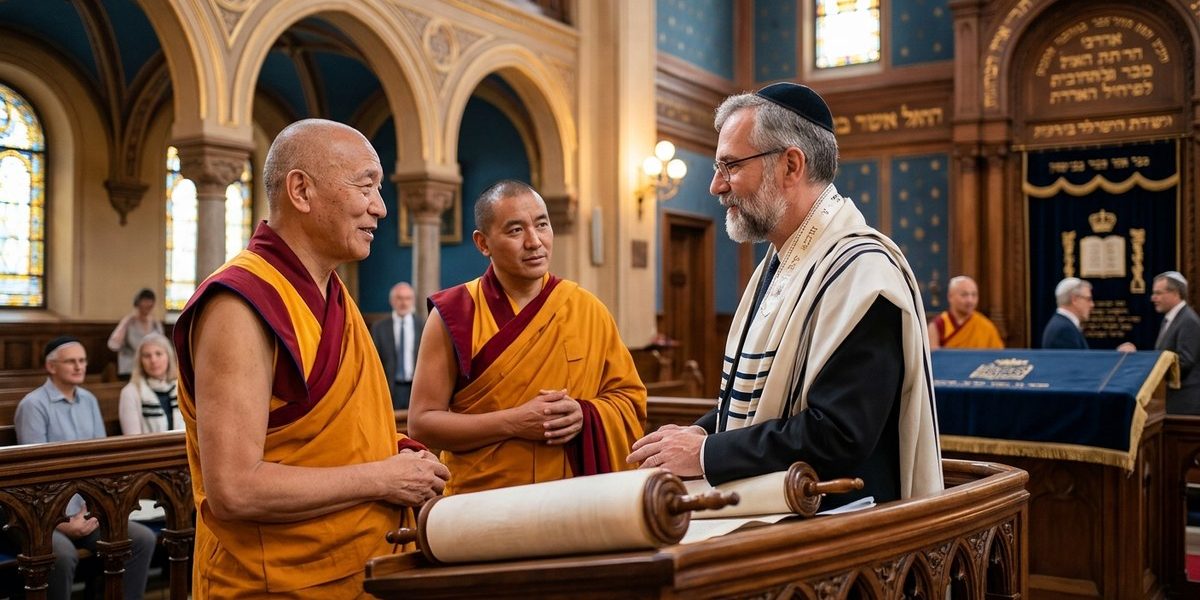
In the spring of 2026, a small van pulled up outside the Jewish Cultural Center in Ljubljana. Out stepped five men in saffron robes, their heads shaved, their eyes calm. They were Buddhist monks from a monastery in the Slovenian countryside, and they had come to see a synagogue. Not for a formal interfaith summit. Not for a photo op. They simply wanted to understand.
When Slovenian Buddhist monks visited a synagogue in 2026, they discovered that two ancient traditions separated by thousands of miles and centuries of history share more than expected. The visit created a blueprint for authentic interfaith encounters, proving that curiosity and humility can dissolve differences and reveal shared values like compassion, study, and community.
This wasn’t a staged event. It grew from a personal connection. One of the monks had attended a lecture on Jewish mysticism in Maribor and wanted to see the physical space where Jewish prayer happens. The local rabbi said yes. And what followed became a lesson in how interfaith encounters should work.
How the Visit Came Together
The planning took three weeks. The monks reached out through a mutual contact. They asked simple questions: When is a good time? Can we sit in the back? Is it okay to ask questions during the service? The Jewish community appreciated the thoughtfulness.
Here is the process they followed, step by step:
- Initial contact. The monks sent an email introducing themselves and their intention. They were clear about their goal: to observe, learn, and ask honest questions.
- Pre-visit conversation. A rabbi and a monk had a 30-minute video call to set expectations. They discussed dress code, photography rules, and what parts of the service would be appropriate for guests to witness.
- The actual visit. The monks arrived 15 minutes before the Friday evening Kabbalat Shabbat service. They sat quietly in a designated area. After the service, they joined a small oneg Shabbat to talk informally.
- Follow-up reflection. A week later, the monks sent a thank-you note and shared what they had learned with their monastic community. They also asked for a glossary of Hebrew terms.
The whole thing was low pressure. No media, no speeches, no forced dialogue. Just presence.
What Happened Inside the Synagogue
The synagogue in Ljubljana is not large. It seats about 80 people. On that Friday evening, the usual crowd of about 30 regulars was joined by the monks. The regulars were surprised but welcoming.
The service began with the traditional Hebrew melodies. The monks sat in perfect stillness. After a few minutes, one of them whispered to the person next to him, asking about the meaning of a particular song. The answer came in a hushed voice: it was a psalm of welcome, “Lecha Dodi.”
After the service, the rabbi invited the monks to share a few words. One of them stood up and said, in careful English, “We noticed that your prayer is like our meditation. You repeat words. You focus. You are present.” The room stayed silent for a moment, then people nodded.
They talked for another hour. Topics included:
- The role of sacred texts in daily life
- How each tradition handles suffering
- The importance of a religious community for people who feel isolated
- The concept of hospitality toward strangers
- The use of chanting and silence in worship
One of the older Jewish members of the community told the monks, “You remind me of my grandfather. He was a cantor. He would close his eyes when he sang, just like you do.”
A Table of Surprising Similarities
| Aspect | Jewish Tradition | Buddhist Tradition (Theravada focus) |
|---|---|---|
| Core practice | Study of Torah and prayer | Meditation and mindfulness |
| Use of repetition | Prayers, psalms, liturgy | Mantras, chanting |
| Role of teachers | Rabbi as scholar and guide | Monk as teacher and exemplar |
| Community gathering | Minyan (10 adults) for prayer | Sangha for collective practice |
| Special clothing | Tallit, kippah, tefillin | Saffron robes, shaved head |
| Concept of compassion | Tikkun olam (repairing the world) | Karuna (compassion) and loving-kindness |
| Relationship with time | Shabbat as sacred time | Uposatha days (observance days) |
| Attitude toward outsiders | Warm hospitality, educational | Welcoming, open to dialogue |
This table emerged from the conversation. It was not planned. The monks and the rabbi wrote it together on a whiteboard. A volunteer snapped a photo and the board is now hanging in the community center.
Lessons for Hosting Interfaith Visitors
If your synagogue, Jewish center, or cultural organization is considering a visit from a group of Buddhist monks (or any other religious community), here are practical tips based on this experience.
- Prepare your regulars. Send a brief email a few days in advance. Tell them who is coming and why. This prevents awkward stares or confusion. People relax when they know what to expect.
- Create a buffer zone. Designate a section of seats for guests. It gives them space to observe without feeling crowded. It also lets your regulars see them as guests rather than distractions.
- Keep the program simple. Do not create a special presentation. Let the service speak for itself. The most powerful moments come from genuine curiosity, not scripted remarks.
- Encourage questions during the social hour. Invite guests to ask anything. The monks asked about the meaning of the ark, the Torah scroll, and why the congregation faced Jerusalem. Each answer led to deeper understanding.
- Follow up. A thank-you note, a photo, a small token. It builds a bridge that can be crossed again. The monks now have an open invitation to return.
“Interfaith work is not about proving who is right. It is about standing in someone else’s house and saying, ‘I see you.’ The monks did that. They did not compare. They observed. They honored.” — Local rabbi, reflecting on the visit
What Made This Visit Work
The synagogue was not a tourist destination for the monks. They were not ticking a box. They came because of a genuine desire to understand how another tradition structures its relationship with the divine. That intention made all the difference.
The Jewish community, in turn, did not treat them as a novelty. They were welcomed as fellow seekers. The regulars did not try to convert them. They did not explain every detail as if the monks were children. They treated them as adults with their own deep tradition, and that mutual respect created a safe space.
One of the monks later wrote in a letter: “We saw that your Shabbat is like our Uposatha. A day of rest and reflection. We did not know that before. Now we understand something about your connection to time.”
The visit also opened doors for other conversations. The Jewish community is now considering a return visit to the monastery. A study group is forming to compare Jewish and Buddhist approaches to mindfulness. And the monks have started reading a translation of the Book of Psalms.
A Lasting Impact on Interfaith Relations in Slovenia
Slovenia is a small country, and its Jewish community is small. But the impact of this visit went beyond the synagogue walls. The local newspaper ran a short piece. The mayor’s office took note. A local school asked if they could bring a class next time.
The monks have since been invited to speak at a Jewish-Christian dialogue meeting in Ljubljana. They are also planning a joint meditation and prayer session for later this year. The idea is not to mix traditions, but to stand side by side and practice in silence.
For the Jewish community, the visit was a reminder that their way of life is not invisible. People want to know about it. People respect it. And sometimes, a group of monks in saffron robes walking through your door is the best thing that can happen.
Common Mistakes When Hosting Unfamiliar Religious Groups
- Overloading visitors with information. Let them absorb. Let them ask.
- Assuming all members of a tradition are the same. These monks were from one specific school. Ask about their background before assuming.
- Forgetting that your regulars also need preparation. They are part of the hospitality.
- Turning the visit into a performance. Keep it authentic.
- Skipping the follow-up. A relationship that ends after one visit is a missed opportunity.
What Slovenian Jewish and Buddhist Communities Can Teach the World
The visit showed that interfaith does not require grand gestures. It requires ordinary people being open. The monks did not come with a pre-approved script. The synagogue did not prepare a PowerPoint. They just showed up, sat together, and talked.
That is the model. It works because it is human.
If you are part of a Jewish community considering a similar visit, start small. Reach out to a local Buddhist center or monastery. Send a simple email: “We would like to welcome you. Please come as you are.” That is how the Slovenian Buddhist monks synagogue visit happened. A simple question. A simple yes. And a room full of people who left knowing a little more about each other.
You Can Create Your Own Interfaith Encounter
You do not need a special occasion. You do not need funding. You just need willingness.
Find a Buddhist group near you. Invite them for a Friday night service or a holiday celebration. Explain what you do. Let them ask questions. Then ask them about their practice. That is how trust builds.
The Slovenian Jewish community has shown that this works. They did it without fanfare. They did it with a small group of monks who had no agenda other than curiosity. The result was a connection that continues to grow.
If you want to read more about how different communities have interacted in Slovenia, check out how Slovenian Jewish and Buddhist communities foster mutual respect. You can also learn from 5 successful interfaith projects that transformed Slovenia’s religious landscape. And if you are curious about the deeper history of Jewish life here, see what role Jewish intellectuals played in Slovenian academic life.
The monks visited in February. By June, they had participated in a community Shabbat dinner. The friendship is real.
So what happens when Slovenian Buddhist monks visit a synagogue? Humanity happens. And that is exactly what we need more of.