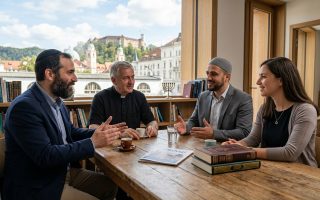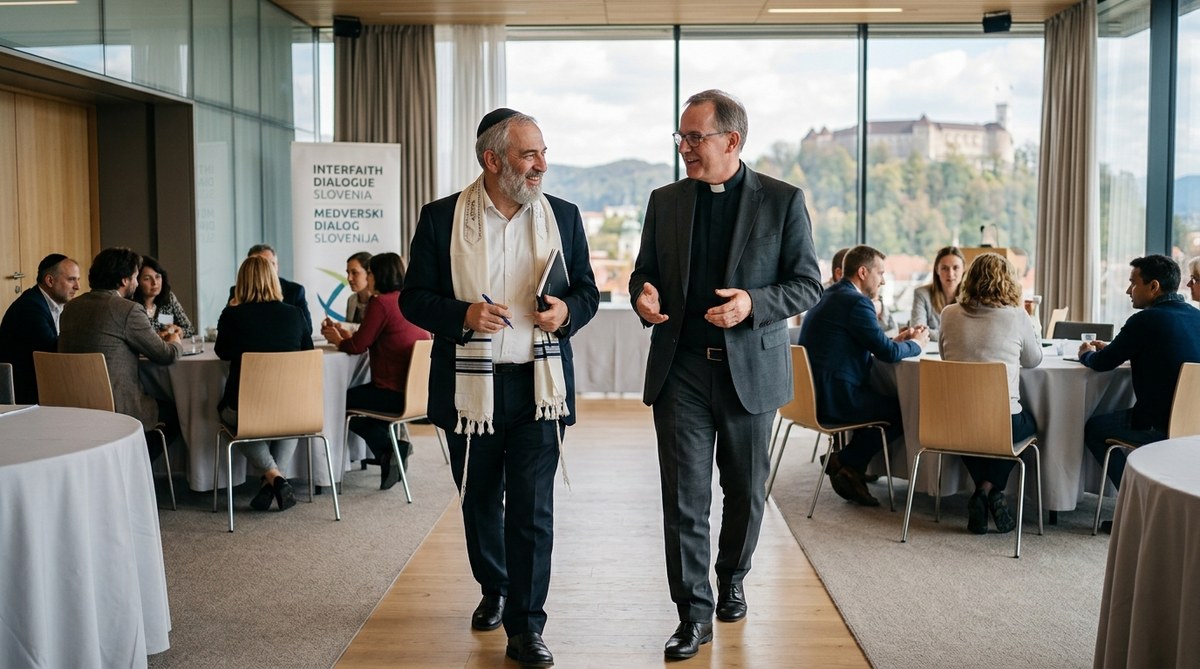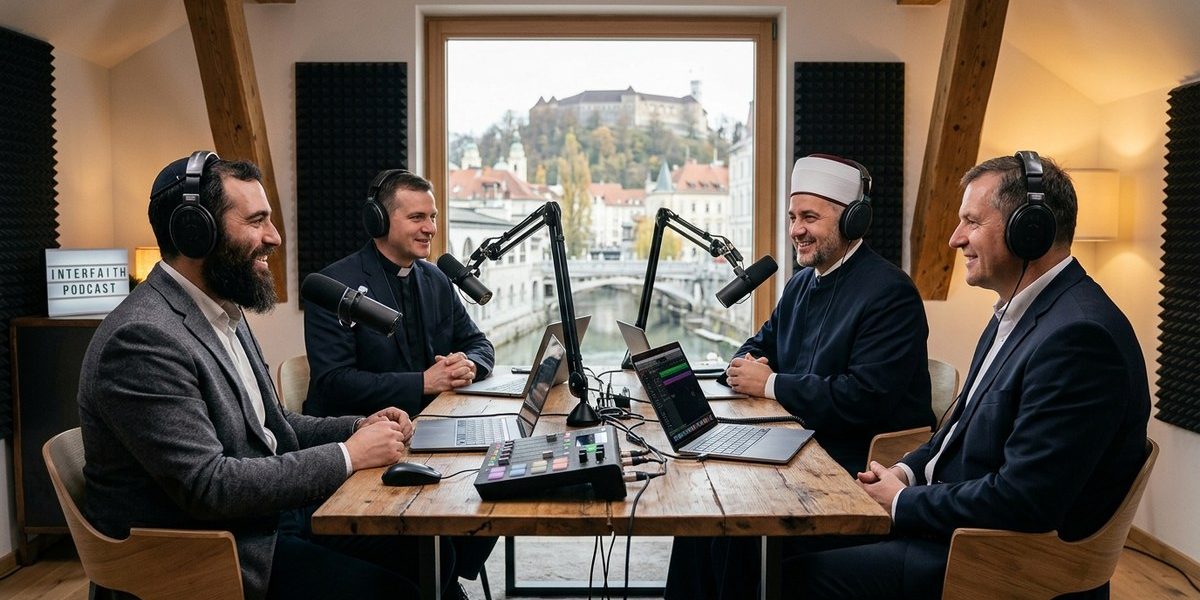
In a small studio in Ljubljana, a Catholic priest, a Muslim imam, and a Jewish community leader sit around a single microphone. They are not debating theology. They are talking about how to tell a difficult truth to a friend, whether forgiveness requires an apology, and what to do when your conscience conflicts with your community. This is not a one-off event. It is the regular rhythm of the Slovenian interfaith leaders podcast, a project that has quietly become one of the most listened-to religious dialogues in Central Europe.
The Slovenian interfaith leaders podcast is not a lecture series. It is a real, unscripted conversation between religious leaders who trust each other. They discuss modern ethical dilemmas that affect everyone, regardless of faith. The show works because it prioritizes human questions over religious labels. For researchers and theology students, it offers a rare case study in how interfaith trust can be built through public, vulnerable dialogue.
Why a Podcast Instead of a Panel
Most interfaith events follow a predictable format. A moderator asks prepared questions. Each leader gives a prepared answer. Everyone nods. Everyone goes home. The format feels safe, but it rarely changes minds.
The leaders behind this podcast wanted something different. They wanted the audio equivalent of a late-night conversation in a kitchen. No notes. No scripts. Just three people who represent different traditions, trying to work out what is right.
Rabbi David Freiberger, one of the founding voices, put it simply in an early episode. “We have spent years doing interfaith dinners where we talk about our holidays. That is good. But we never talked about what keeps us up at night. This podcast is an attempt to fix that.”
The choice of podcasting as a medium matters. Audio forces listeners to focus on tone, hesitation, and sincerity. You cannot see someone’s clerical collar or head covering. You only hear their voice wrestling with a question.
The Format That Builds Trust
Each episode follows a structure that feels both loose and intentional.
- A real-world ethical dilemma is introduced. It might come from the news, a congregant’s question, or something that happened to one of the hosts that week.
- Each leader responds from their tradition. They do not read scripture. They explain how their faith shapes their thinking on the issue.
- They respond to each other. This is the heart of the show. They push back. They ask clarifying questions. They sometimes change their minds.
- They land on shared ground or agree to disagree. The goal is not consensus. It is understanding.
This format avoids the trap of comparative religion, where each leader gives a mini-lecture about what their faith says. Instead, the conversation stays focused on the human problem at hand.
What They Talk About
The topics are not abstract. Recent episodes have covered:
- How to handle a family member who holds racist views
- Whether it is ethical to lie to protect someone’s feelings
- What to do when your workplace demands something your faith forbids
- How to grieve publicly when your tradition has different mourning practices
- Whether religious communities should take political stands
These are not niche theological debates. They are the kinds of questions that come up in real life. That is why the podcast has found an audience beyond religious circles. Journalists covering European ethics have referenced episodes. University courses in Ljubljana and Zagreb have assigned episodes as listening material.
What Makes This Different from Other Interfaith Work
Interfaith dialogue often fails because it avoids friction. Leaders stick to safe topics like shared holiday meals or common values. That work has value, but it can feel like a performance.
This podcast takes a different approach. The leaders do not pretend to agree. In one memorable episode, the imam and the rabbi had a genuine disagreement about whether intent matters more than outcome when judging an action. The conversation got heated. Then it got honest. By the end, neither had converted the other, but both had refined their own positions.
That kind of friction is rare in public interfaith work. It is also what makes the podcast compelling.
| Common Interfaith Mistake | How the Podcast Does It Differently |
|---|---|
| Leaders give prepared statements | Leaders speak without scripts |
| Topics stay on safe cultural ground | Topics include moral gray areas |
| Disagreement is smoothed over | Disagreement is explored openly |
| Audience is passive | Audience feels like they are listening in on a real conversation |
| Each leader represents a “position” | Each leader represents a person with doubts |
How to Listen Like a Researcher
If you are a theology student or a journalist studying this project, do not just listen to the content. Pay attention to the context.
- Notice how the leaders refer to each other. They use first names, not titles. That choice signals equality.
- Listen for moments of silence. They are rare in religious broadcasting. Here, they happen when a leader is genuinely thinking.
- Track how often they reference their own doubt. In traditional religious media, leaders project certainty. In this podcast, they project honesty.
“The moment I stopped trying to represent my entire tradition was the moment I started actually learning from my colleagues.”
* Imam Alija Sulejmani, speaking in an episode about religious authority
The Broader Significance for European Interfaith Relations
Slovenia is a small country with a small Jewish population. That might seem like a limitation. In practice, it is an advantage. When communities are small, leaders cannot afford to stay in silos. They run into each other at the grocery store. Their children go to the same schools. The podcast grows out of that daily familiarity, not a formal initiative.
This model could work in other European contexts where religious communities are small but diverse. The key ingredient is not budget or production quality. It is trust built over years of shared life.
For American readers, the contrast is instructive. In the United States, interfaith work often happens through large organizations with professional staff. In Slovenia, it happens because a rabbi and an imam live on the same street and decided to start recording their conversations.
Practical Lessons for Starting Something Similar
If you are inspired to start a similar project in your own community, the process is simpler than you might think.
- Find one person from a different tradition who you genuinely like talking to. Do not start with an institution. Start with a relationship.
- Agree on a format that feels natural. It does not have to be a podcast. It could be a shared blog, a video series, or a live conversation.
- Choose topics that are specific and personal. Avoid “What does your faith say about peace?” and ask “What did you tell your child after they were bullied?”
- Record and release the first few conversations without overthinking. Perfectionism kills interfaith work faster than disagreement.
- Share the results with your communities and ask for honest feedback. Let the audience shape where the conversation goes next.
Connecting This to Broader Slovenian Jewish Life
This podcast is part of a larger story. The Jewish community in Slovenia is small, but it is active in building bridges. The same spirit that animates this podcast can be seen in other projects across the country. For example, the work of building bridges between Jewish and Catholic communities in Ljubljana follows a similar logic of personal relationship over institutional programming.
There are also lessons here for how Slovenian religious leaders are building interfaith collaborations more broadly. The podcast is not an isolated experiment. It is a symptom of a community that has chosen connection over comfort.
A New Kind of Religious Leadership
The Slovenian interfaith leaders podcast matters because it models a kind of religious leadership that is becoming more necessary. Leaders who can think out loud. Leaders who can admit uncertainty. Leaders who can disagree without becoming enemies.
For the researcher, this is a primary document of how faith adapts to pluralism in real time. For the journalist, it is a story about a small country that figured out something big. For the theology student, it is a case study in applied ethics that no textbook can replicate.
The podcast does not claim to solve the world’s problems. It just claims to be honest about them. That honesty is rare. And it is why people keep listening.
How to Start Listening Today
You can find the Slovenian interfaith leaders podcast on most major platforms. If you are new to the show, start with an episode that addresses a topic you care about. Listen to how the leaders talk to each other before you focus on what they say. The tone is the real content.
And if you are a student of religious dialogue, take notes. You are watching a new model of interfaith work being built in real time, one conversation at a time.