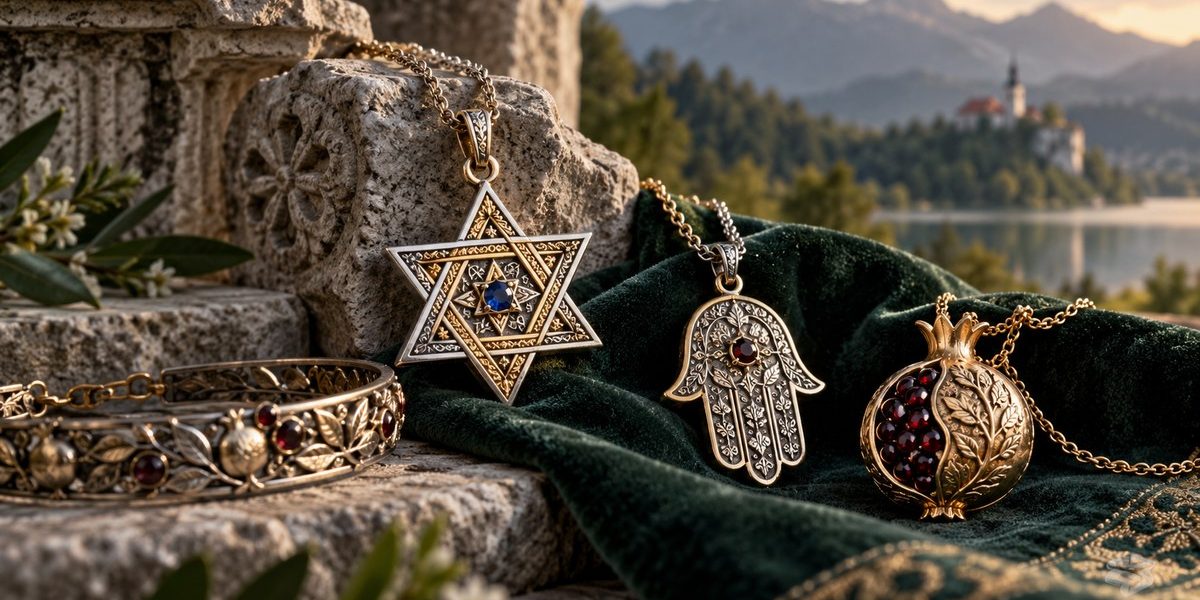
A silver Star of David catches the light as it swings from a chain. A mother hands her daughter a delicate Hamsa pendant before a long trip. A groom places a simple ring on his bride’s finger under the chuppah. These moments are not just about fashion. They are about memory, protection, and belonging. Jewish jewelry carries a secret language that speaks across centuries and continents. In a small but vibrant community like Slovenia’s, these symbols hold even deeper meaning. They connect the wearer to a global story while grounding them in a local identity. Understanding the language of these pieces helps us see how faith and history can be worn close to the heart.
Jewish jewelry symbols like the Hamsa, Chai, and Star of David are more than decorative. They serve as portable amulets, statements of identity, and links to Jewish history. In Slovenia, these pieces also represent resilience and the revival of a community that has faced expulsion and near-erasure. Understanding these symbols helps travelers and historians appreciate the depth of Jewish cultural heritage in unexpected places.
The Stories Woven Into Silver and Gold
Jewish jewelry is rarely just ornament. Each motif carries a specific purpose or prayer. For centuries, Jewish communities across Europe, including those in the historic towns of Slovenia, used jewelry to mark life cycle events, ward off evil, and declare their faith in a world that often made that declaration dangerous.
The most common symbols you will encounter include the Star of David, the Hamsa, the Chai, and the Menorah. Each one has layers of meaning that change depending on where and how it is worn.
The Star of David (Magen David)
This six-pointed star is the most recognized symbol of Jewish identity today. But its use as a specifically Jewish emblem is surprisingly recent. It became widespread in the 17th century in Prague and later in the 19th century as a universal sign of Judaism. In Slovenia, you can see the Star of David on gravestones in the Jewish cemetery in Rožna Dolina and on ceremonial objects in the Ljubljana synagogue. When worn as jewelry, it often represents a connection to the State of Israel, a sense of pride, or a family heirloom passed down through generations.
The Hamsa Hand
The Hamsa, a palm-shaped amulet with an eye in the center, is one of the oldest protective symbols in the world. It predates Judaism but was adopted by Jewish communities across North Africa and the Middle East. In Slovenia, the Hamsa has become a popular piece for both Jews and non-Jews who appreciate its message of protection. The word “Hamsa” comes from the Arabic word for five, representing the five fingers and the five books of the Torah. When you see a Hamsa pendant in Ljubljana, it is a sign that the wearer values spiritual protection and good fortune.
The Chai Symbol
The word “Chai” means “life” in Hebrew. It is made up of two Hebrew letters: Chet and Yud. The numerical value of these letters adds up to 18, which is why multiples of 18 are considered lucky in Jewish tradition. A Chai pendant is a daily reminder to cherish life. In Slovenian Jewish homes, you might find a Chai hanging on a wall or worn as a necklace. It is a simple but powerful statement of survival and gratitude.
The Menorah
The seven-branched menorah is the oldest symbol of Judaism, dating back to the Temple in Jerusalem. A nine-branched version is used for Hanukkah. In jewelry, the menorah is often depicted in a stylized form. It represents light, wisdom, and the enduring nature of the Jewish people. For the Jewish community in Slovenia, the menorah is a reminder of the Hanukkah miracle and the rededication of the Temple. It also symbolizes the light that the community continues to bring to the region.
How to Read a Piece of Jewish Jewelry
When you encounter a piece of Jewish jewelry, you can decode its meaning by looking at a few key elements. Here is a simple process to follow.
- Identify the primary symbol. Is it a Star of David, a Hamsa, a Chai, or something else? Look for Hebrew letters, which often spell out a word like “Shaddai” (one of the names of God) or “Yisrael.”
- Check the material. Silver is the most traditional metal for Jewish ritual objects. Gold is often used for wedding rings and special gifts. A piece made from a specific metal might tell you about its intended use or the status of the original owner.
- Look for inscriptions on the back. Many pieces have a blessing, a date, or a name engraved on the reverse. This can turn a simple pendant into a personal amulet or a commemorative item.
- Consider the context. A piece bought in a tourist shop in Maribor might have a different story than a piece inherited from a grandmother who fled Slovenia during World War II. Ask about the origin if you can.
Common Symbols and Their Meanings at a Glance
The table below shows some of the most frequent symbols found in Jewish jewelry and what they represent.
| Symbol | Hebrew Name | Primary Meaning | Common Use in Jewelry |
|---|---|---|---|
| Six-pointed star | Magen David | Jewish identity, connection to Israel | Pendants, rings, earrings |
| Open hand with eye | Hamsa | Protection from the evil eye, blessings | Pendants, bracelets, keychains |
| Two Hebrew letters (Chet, Yud) | Chai | Life, luck, vitality | Pendants, charms, wall hangings |
| Seven-branched lamp | Menorah | Temple, light, wisdom | Pendants, brooches, ceremonial items |
| Hebrew letter “Shin” | Shaddai | Divine protection, God’s name | Pendants, amulets for children |
| Pomegranate | Rimmon | Fertility, knowledge, righteousness | Earrings, pendants, wedding gifts |
Why These Symbols Matter in Slovenia
Slovenia’s Jewish history is one of great richness and great loss. Medieval communities thrived in Maribor and Ptuj. Then came expulsions in the 15th and 16th centuries. A small community re-emerged in the 19th century, only to be devastated during the Holocaust. Today, the Jewish community of Slovenia is small but active. For them, wearing Jewish jewelry is a public act of identity. It says, “We are still here.”
A historian visiting Ljubljana might notice a woman wearing a simple silver Chai necklace. That piece is not just a fashion choice. It is a connection to the 5 Influential Slovenian Jewish Families Who Shaped Modern Slovenia. It is a link to the How Slovenian Jews Survived the Holocaust: Stories of Resistance and Rescue. It is a quiet declaration of continuity.
A Practical Guide to Buying or Identifying Jewish Jewelry
If you are a traveler or a collector looking for authentic Jewish jewelry in Slovenia, keep these tips in mind.
- Look for hallmarks. Silver pieces should have a purity mark (925 for sterling). Gold pieces should show karat weight.
- Ask about the artist. Slovenia has a tradition of skilled artisans. Some contemporary jewelers create modern interpretations of classic Jewish symbols. You can learn more about this craft in the article about Uncovering the Influence of Jewish Artisans and Crafts in Slovenian Cultural Heritage.
- Check the Hebrew. If the piece has Hebrew letters, make sure they are correctly formed. A poorly made or misspelled piece might not carry the intended meaning.
- Consider the source. Buy from reputable dealers, museums, or directly from the Jewish community. This ensures the piece is made with respect and understanding.
“A piece of Jewish jewelry is a portable story. It carries the memory of a family, the hope of a people, and the faith of an individual. When you wear it, you become part of that story.” — A member of the Ljubljana Jewish community
Mistakes to Avoid When Interpreting Jewish Jewelry
It is easy to misunderstand the meaning of a symbol if you do not know its context. Here are some common mistakes.
- Assuming all Hamsas are Jewish. The Hamsa is also used in Islamic and Christian cultures. Its meaning can vary. Always look for additional Jewish symbols, like a Star of David or Hebrew text, to confirm its specific cultural context.
- Thinking the Menorah is only for Hanukkah. The seven-branched menorah is a symbol of the ancient Temple and is the official emblem of the State of Israel. The nine-branched Hanukkiah is specifically for the holiday of Hanukkah.
- Overlooking the importance of the number 18. Because Chai equals 18, gifts of money in multiples of 18 are traditional. A piece of jewelry set with 18 small stones or featuring 18 links is a subtle reference to Chai.
- Ignoring regional styles. Slovenian Jewish jewelry might have influences from Central European, Ashkenazi, and even Sephardic traditions. The design can tell you about the history of the family that owned it. For more on this, read about Tracing the Sephardic Roots of Slovenia’s Earliest Jewish Settlers.
The Secret Language of Gemstones and Colors
Beyond the primary symbols, the choice of gemstone or color in Jewish jewelry can add another layer of meaning.
- Turquoise and blue are commonly associated with the Hamsa and are believed to offer protection against the evil eye.
- Red string is often worn on the wrist as a kabbalistic amulet for protection. You will sometimes see it tied around a silver or gold bracelet.
- Garnet is a traditional stone used in Jewish jewelry from Central Europe. It was popular in Bohemia and Moravia, regions with close ties to Slovenian Jewish history.
- Diamonds are used in wedding rings, symbolizing purity and enduring strength.
When you see a piece with a specific stone, ask yourself why that stone was chosen. The answer often reveals the purpose of the jewelry.
How to Care for and Preserve Jewish Heirlooms
If you own or inherit a piece of Jewish jewelry, proper care ensures it lasts for future generations.
- Store silver in anti-tarnish cloths. Silver reacts to air and can darken over time.
- Keep pieces separate. Gold is soft and can be scratched by harder stones or metals.
- Have clasps checked by a jeweler. Old clasps can fail, leading to lost pieces.
- Document the story. Write down who owned the piece, where it came from, and what it means. This oral history is as valuable as the metal itself.
Connecting Symbols to Place
The meaning of a symbol can change depending on where you are. In Slovenia, the Star of David is not just a religious symbol. It is also a marker of a community that has rebuilt itself after near destruction. Wearing a Star of David in Ljubljana today is an act of courage and hope.
When you visit the The Hidden Synagogues of Medieval Ljubljana: Uncovering Lost Jewish Architecture or explore the Rediscovering the Jewish Quarter of Ptuj Through Archaeological Finds, you will see how these symbols were once part of daily life. They were carved into doorways, woven into textiles, and stamped onto coins. Today, they live on in the jewelry worn by community members and visitors alike.
A Final Look at the Language of Adornment
Jewish jewelry symbols are a language that does not need words. A Chai pendant says “I choose life.” A Hamsa says “May you be protected.” A Star of David says “I am part of a people that has endured.” In Slovenia, these messages are especially powerful. They speak of a community that has faced expulsion, persecution, and silence, yet continues to create beauty and meaning.
The next time you see a piece of Jewish jewelry, take a moment to read it. Look at the symbols. Notice the materials. Think about the hands that made it and the hands that wore it. You might find a story that connects you to a history you never knew.
If you are interested in learning more about the artistic expressions of this community, you can read about How Jewish Artists Shaped Modern Art Movements in Central Europe. For a deeper look at the region’s cultural tapestry, see The Melodic Legacy: Traditional Klezmer Music and Its Slovenian Connections. And if you are planning a visit, the guide on How to Explore Slovenia’s Jewish Heritage Trail in 2026: A Complete Guide will help you see these symbols in their original context.
Wear the story. Share the meaning. The secret language of Jewish jewelry is waiting for you to speak it.