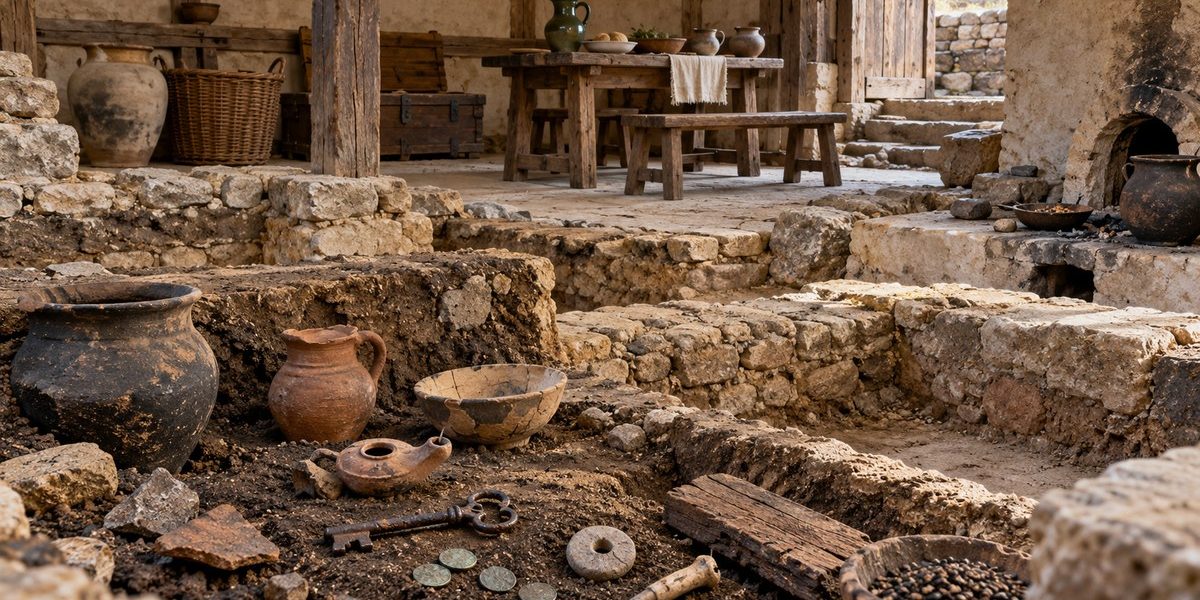
In the spring of 2026, a team of archaeologists working near the old town center of Ljubljana made a discovery that stopped them in their tracks. Beneath layers of modern pavement and medieval rubble, they uncovered the stone foundations of a Jewish home that had stood quietly for centuries, holding the secrets of the people who lived, cooked, prayed, and raised children within its walls. For anyone fascinated by medieval Jewish daily life, this excavation offers something rare: a direct connection to the ordinary moments of a community that history books often reduce to a single line. The objects found here tell a story of resilience, faith, and the universal need to create a home.
The 2026 excavation of a medieval Jewish home in Ljubljana provides one of the most complete pictures of Ashkenazi domestic life from the 14th and 15th centuries. Artifacts like a stone oven, kosher-style animal bones, a worn prayer book fragment, and a hidden coin hoard reveal how this family balanced religious observance with the daily demands of survival in a Christian city. The site proves that Jewish daily life was both deeply private and openly public, with clear boundaries of faith drawn inside the home.
What the excavation team found beneath the floor
The dig site, located on what was once the edge of the Jewish quarter, covered about 400 square feet of living space. The team from the University of Ljubljana worked in careful layers, documenting every shard and seed. What emerged was a single-story stone house with three rooms: a main living area, a small kitchen, and a storage cellar.
The most emotional find came from under the kitchen floor. Tucked into a clay pot was a small cache of silver coins, likely the family’s emergency savings. The latest coin bore the date 1496, the same year the Jewish community was expelled from Ljubljana by Emperor Maximilian I. This family had hidden their wealth before they left, hoping to return. They never did.
Other artifacts painted a fuller picture of domestic routines:
- A stone oven with traces of grain and soot, showing how bread was baked for Shabbat.
- Fragments of glazed pottery from local workshops, suggesting the family bought from Christian neighbors.
- A bronze candlestick holder, bent and worn from use, probably for lighting the Sabbath candles.
- Animal bones with cut marks that match kosher slaughter patterns, indicating the family kept dietary laws.
- A small silver ring with a Hebrew inscription that reads “Mazal Tov,” likely a wedding band.
Each object is a thread in a larger story. Together, they show a household that was fully engaged in the rhythms of medieval Ljubljana while maintaining a distinctly Jewish identity.
How archaeologists reconstruct daily life from fragments
Turning a broken pot into a story takes patience and science. The team used several methods to piece together how this family lived.
- Stratigraphy and soil analysis. By mapping the layers of dirt and debris, they could tell which objects were in use at the same time. Ash layers near the oven matched the period of the coins, confirming the home was occupied continuously for about 80 years.
- Archaeobotany. Seeds and pollen grains found in the kitchen were examined under microscopes. They found wheat, barley, lentils, and poppy seeds, all common in medieval Ashkenazi cooking. No pig remains were found, which aligns with kosher practice.
- Ceramic reconstruction. Broken pottery was pieced together like a puzzle. The shapes of the bowls and jars matched types used for storing oil, wine, and water, essential for a household that needed to keep separate sets of dishes for meat and dairy.
This process is slow, but every detail matters. A single seed can tell you what someone ate for dinner 500 years ago.
What the home reveals about Jewish identity in a Christian city
Living as a minority in medieval Ljubljana meant navigating a world of restrictions. Jews were confined to a specific quarter, barred from most guilds, and required to wear identifying badges. But inside their homes, they controlled the space.
The layout of this house shows a clear effort to create a Jewish environment. The kitchen was positioned away from the street entrance, likely to keep food preparation private. A small niche in the wall, lined with plaster, may have held a mezuzah. The family’s religious objects were kept close, not hidden.
The discovery of a single page from a prayer book, written on parchment in Hebrew, is especially moving. The text is from the morning blessings. Someone read these words every day, finding comfort in the familiar phrases. The page was folded and worn, perhaps carried in a pocket or tucked into a belt.
This careful separation of the sacred and the mundane is a theme across the site. The family did not hide their Judaism, but they did not flaunt it either. They lived their faith quietly, in the small choices of daily life.
A practical guide to understanding medieval Jewish household archaeology
For history enthusiasts who want to interpret these finds themselves, here is a table that breaks down the most common artifact types and what they mean.
| Artifact Type | What It Tells Us | Common Mistakes to Avoid |
|---|---|---|
| Animal bones | Diet, kosher status, economic class | Assuming all sheep bones mean meat was eaten daily. Most families used meat sparingly, mainly for Shabbat. |
| Pottery shards | Trade networks, food storage, cooking methods | Confusing local Slovenian pottery with imported German wares. Local clay has a distinct reddish hue. |
| Coins | Date of occupation, wealth level, political events | Thinking a single coin date proves the exact year the home was abandoned. Coins stayed in circulation for decades. |
| Religious objects | Personal piety, community connections, literacy | Assuming every Hebrew-inscribed item was for prayer. Some were decorative or used for good luck. |
| Seeds and grains | Agriculture, seasonality, trade routes | Overlooking the fact that seeds can be carried by wind or rodents. Context matters for every sample. |
“We have to be careful not to romanticize the past,” says Dr. Maja Kos, the lead archaeologist on the Ljubljana dig. “These were real people facing real hardships. The beauty of archaeology is that it forces us to see them as they were, not as we wish them to be. Every object is a fact, but it takes humility to read it correctly.”
How this site changes what we know about medieval Jewish life in Slovenia
Before this excavation, most of what we knew about the Jewish community of Ljubljana came from legal documents and tax records. Those sources tell us about restrictions, payments, and expulsions. They do not tell us about the smell of baking bread on a Friday afternoon or the weight of a wedding ring on a finger.
This home changes that. It provides a physical anchor for a community that has often been invisible in the historical record. The artifacts show that this family was integrated into the local economy while maintaining a strong internal religious life. They bought pots from Christian potters, but they kept kosher. They spoke Slovenian in the market, but they prayed in Hebrew at home.
The site also challenges the idea that medieval Jewish communities were isolated. The pottery and coin types show connections to trade routes stretching to Venice and Vienna. This was not a closed-off ghetto. It was a neighborhood of people who participated in the larger city while protecting their own traditions.
For more on the broader context of Jewish life in this region, you can read about how Jewish traders shaped Slovenia’s medieval economy. The economic ties between Jewish families and their Christian neighbors were more complex than many assume.
What the future holds for the Ljubljana excavation
The dig is not finished. The team plans to return in the summer of 2027 to expand the trench and search for neighboring homes. They hope to find a communal oven or a small synagogue, which would fill in more gaps about how the community gathered.
For now, the artifacts are being cleaned, cataloged, and studied at the National Museum of Slovenia. Some will eventually be displayed in a permanent exhibition about medieval Ljubljana. The goal is to let the objects speak for themselves, telling the story of a family that lived, loved, and lost their home five centuries ago.
What this means for understanding Jewish resilience
The story of this family does not end with expulsion. The fact that we can stand in their kitchen, touch their oven, and read their prayer book is a testament to the lasting mark they left on the city. They were forced out, but their presence remains.
This excavation reminds us that Jewish history is not just a story of persecution. It is a story of everyday life, of mothers feeding children, of fathers teaching prayers, of families celebrating weddings and mourning losses. These are the moments that build a community, and they are worth remembering.
If you want to learn more about the cultural contributions of Slovenian Jews, consider reading about the hidden synagogues of medieval Ljubljana. The architectural traces of this community are still being uncovered across the city.
The 2026 excavation gives us a rare gift: a window into a world that was almost lost. Let us use it to remember not just how they suffered, but how they lived. Next time you walk through an old city, take a moment to think about the layers beneath your feet. Someone else walked there too, and their story is waiting to be told.