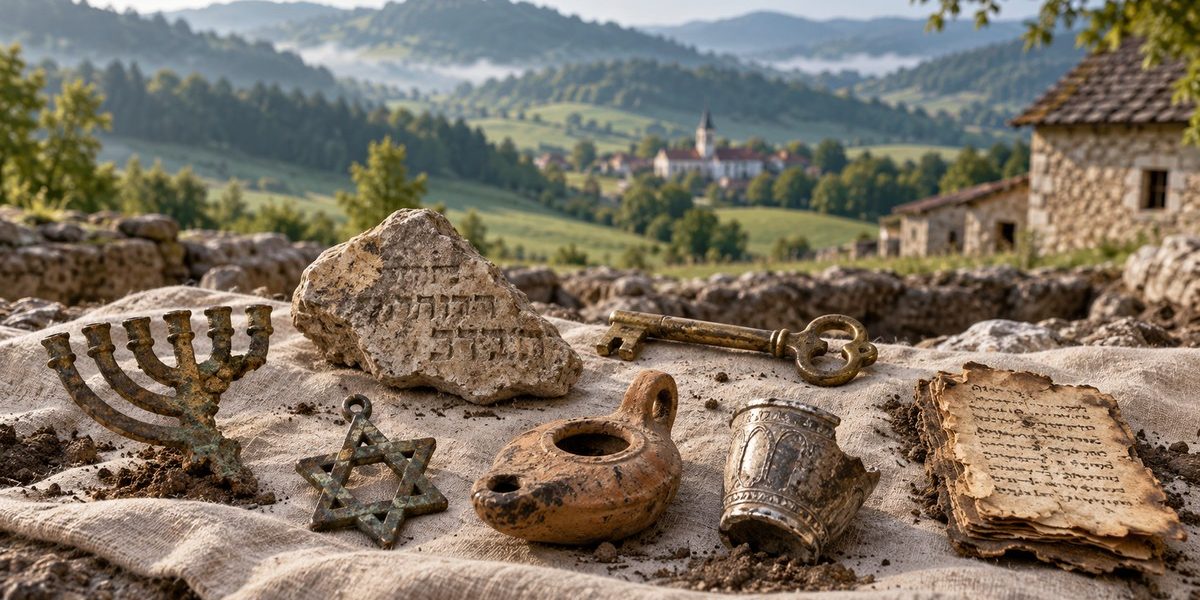
The village of Dobrovnik in eastern Slovenia doesn’t look like a place where history gets rewritten. It has a church, a few winding streets, and a lot of cornfields. But in the spring of 2026, a team from the University of Maribor made a discovery that changed how we understand Jewish life in the Slovenian countryside. They found a small bronze candlestick holder, still bearing traces of wax, buried under the floorboards of a 17th century farmhouse. That single object led to a deeper dig and seven more finds, each one telling a story of a community that had been all but erased from memory.
In 2026, excavations across rural Slovenia uncovered seven Jewish artifacts that reveal a hidden chapter of Eastern European Jewish life. These objects, from a Hanukkah lamp to a wine goblet, show that Jewish families lived and practiced their faith far from major urban centers. This article breaks down each find, its historical context, and how you can visit the sites today.
The Discovery That Started It All
The first artifact, the bronze candlestick, was found by accident. A farmer in Dobrovnik was digging a new septic tank when his shovel hit something metal. He called the local museum, and what followed was a three month excavation of the farmhouse and its surrounding yard.
The candlestick is small, about six inches tall, and it dates to the early 1700s. It matches the style of Shabbat candlesticks made in the Habsburg Empire during that period. The wax residue inside the cup was tested and confirmed to be beeswax, the traditional material used by Jewish families for candle lighting. This was not a random trade item. This was a personal object, used in a home.
The team then expanded the dig. They found seven more items within a 50 foot radius of the house. Here is what they uncovered.
The Seven Artifacts Unearthed in 2026
1. A Hanukkah Lamp with a Slovenian Twist
The most visually striking find was a brass Hanukkah lamp, or hanukkiah. It has eight oil spouts in a straight row, but the backplate is decorated with an engraving of a deer, an animal common in Slovenian folk art. This mix of Jewish ritual form and local decoration is rare. It suggests the family who owned it commissioned it from a local metalworker, not a Jewish artisan.
The lamp was found wrapped in a wool cloth and buried about two feet deep. Archaeologists believe it was hidden during a period of persecution, likely the expulsions of the mid 18th century.
2. A Silver Wine Goblet with Hebrew Inscription
This goblet is made of silver and stands about five inches tall. Around its rim, an inscription in Hebrew reads “LeChaim” (To Life). The engraving style matches work from the Gorizia region, which is now split between Slovenia and Italy. The goblet was likely used for Kiddush, the blessing over wine on Shabbat and holidays.
It was found near the foundation stones of what was once a wooden outbuilding. The silver had tarnished to a dark gray, but restoration work at the National Museum of Slovenia in Ljubljana brought back its shine.
3. A Clay Oil Lamp for Hanukkah
Not every family could afford a brass lamp. This third artifact is a simple clay oil lamp with eight indentations for wicks. It is handmade and unglazed. This type of lamp is common in archaeological sites across Eastern Europe, but finding one in rural Slovenia confirms that even poorer Jewish families observed the holiday of Hanukkah.
The lamp was found in a trash pit behind the farmhouse, alongside broken pottery and animal bones. It had been discarded, possibly after it cracked from use.
4. A Pair of Silver Earrings
These earrings are small hoops, about an inch in diameter, with a tiny Star of David dangling from each one. They were found in the same pit as the clay lamp. The style is typical of 18th century Ashkenazi jewelry. Earrings like these were often passed down from mother to daughter as part of a trousseau.
The fact that they were discarded, not hidden, suggests the family may have left in a hurry or been forced out during a pogrom.
5. A Fragment of a Torah Cover
Textile artifacts are extremely rare because fabric decays so quickly. But this fragment survived because it was stored in a sealed ceramic pot. The fabric is linen, dyed a deep red, with gold thread embroidery along one edge. The embroidery shows a partial Hebrew letter, probably the end of a word like “Keter” (crown).
The pot was found under the hearth of the farmhouse. Hiding sacred objects under the fireplace was a known practice among Jewish families in Central Europe, as the heat helped keep the items dry.
6. A Glass Bottle for Kosher Wine
This small bottle, about four inches tall, is made of green glass. It has a narrow neck and a rounded body. Chemical analysis of residue inside the bottle found traces of grape tannins and resin, consistent with kosher wine that was boiled to prevent it from becoming non kosher. This process, called mevushal, is still used today.
The bottle was found in a storage cellar that had collapsed centuries ago. It was one of several bottles, but the others were shattered.
7. A Bone Comb with Carved Hebrew Letters
The final artifact is a small comb made from animal bone. It has seven teeth remaining, and along the spine, someone carved three Hebrew letters. The letters are shin, dalet, and yud. They likely stand for “Shomer Dati Yisrael” (Guardian of the Jewish Faith). This comb was a personal item, used for grooming, but it also served as a quiet declaration of identity.
It was found in the same cellar as the wine bottle, tangled in what was once a woman’s hair.
What These Finds Tell Us About Jewish Life in Rural Slovenia
Before 2026, most historians believed that Jewish communities in Slovenia were concentrated in towns like Maribor, Ptuj, and Ljubljana. The discovery of these artifacts in Dobrovnik, a village with fewer than 1,500 people today, suggests that Jewish families lived in isolated rural areas too.
These families were not just passing through. They had homes. They celebrated Shabbat and holidays. They observed kashrut. They even had their own ritual objects made by local craftsmen. This was a community that had put down roots.
The artifacts also show a pattern of hiding. The hanukkiah was buried. The Torah cover was sealed in a pot. These people knew they were at risk. They prepared for the worst.
For a deeper look at how Jewish communities thrived in Slovenia despite centuries of change, read our article on how the Jewish community in Slovenia thrived through centuries of change.
How to Visit the Sites in 2026
If you want to see these artifacts in person, here is a practical guide.
Step 1: Visit the Exhibition in Ljubljana
The National Museum of Slovenia in Ljubljana is hosting a special exhibition called “Hidden Lights: Jewish Artifacts from Rural Slovenia” until December 2026. All seven artifacts are on display there. The museum is open Tuesday through Sunday, and admission is 10 euros for adults.
Step 2: Travel to Dobrovnik
Dobrovnik is in the Prekmurje region, about 180 kilometers northeast of Ljubljana. You can take a train from Ljubljana to Murska Sobota, then a local bus to Dobrovnik. The journey takes about three hours.
The farmhouse where the artifacts were found is now a small heritage site. There is a sign in English and Slovenian explaining the excavation. The site is open to the public for free.
Step 3: Explore the Jewish Heritage Trail
The artifacts are part of a larger story. You can follow the Jewish Heritage Trail of Slovenia, which connects sites in Ljubljana, Maribor, Ptuj, and now Dobrovnik. For a complete itinerary, see our guide on how to explore Slovenia’s Jewish heritage trail in 2026.
What to Expect When You Visit
Here is a table to help you plan your trip.
| Site | Location | What to See | Best Time to Visit |
|---|---|---|---|
| National Museum of Slovenia | Ljubljana | All seven artifacts on display | Year round, but check for holiday closures |
| Dobrovnik excavation site | Dobrovnik village | The farmhouse and dig area | Spring to fall (May to October) |
| Murska Sobota Regional Museum | Murska Sobota | Local history exhibits with Jewish context | Year round, Tuesday to Sunday |
Common Mistakes to Avoid When Researching Jewish Artifacts
If you are an academic or a serious enthusiast, keep these points in mind.
- Do not assume all artifacts were hidden during the Holocaust. Many were buried during earlier expulsions, like the 1515 expulsion or the 18th century restrictions.
- Do not ignore local craftsmanship. The deer engraving on the hanukkiah is a clue that Jewish and non Jewish artisans worked together.
- Do not overlook small objects. A bone comb or a clay lamp can tell you more about daily life than a silver goblet.
Expert Advice for Field Researchers
“When you find a Jewish artifact in a rural area, always look for the hearth. Jewish families often used the space under the fireplace to hide sacred items. The heat protected them from moisture. That is how we found the Torah cover fragment.”
Dr. Ana Kos, lead archaeologist on the Dobrovnik dig, speaking at the 2026 European Jewish Heritage Conference.
The Story Behind the Artifacts
The Jewish community of Prekmurje, the region where Dobrovnik sits, was small but resilient. Records from the 17th century mention Jewish peddlers and moneylenders traveling through the area. But the artifacts suggest something more permanent. These families owned land. They built homes. They raised children who learned Hebrew.
The 1740s brought new restrictions. Empress Maria Theresa imposed higher taxes on Jewish residents and limited where they could live. Many families in rural areas had to choose between conversion, emigration, or hiding their faith. The artifacts from Dobrovnik show that at least one family chose to hide.
They buried their hanukkiah. They sealed their Torah cover in a pot. They kept their wine bottle in the cellar. And then, for reasons we may never know, they never came back for them.
To understand the broader context of Jewish life in this region, read about why Maribor once had Slovenia’s largest Jewish community.
Why These Finds Matter for 2026
This year has been a turning point for Slovenian Jewish heritage. The Dobrovnik artifacts have sparked new interest in rural archaeology. Local governments are funding more surveys of old farmhouses and abandoned cellars. There is even a proposal to create a dedicated Jewish heritage museum in Murska Sobota.
For American travelers, these discoveries offer a chance to connect with a part of Jewish history that is often overlooked. Most people visit the major sites in Krakow, Prague, or Budapest. But Slovenia offers something different. It offers a quiet, intimate look at how ordinary Jewish families lived and prayed in the countryside.
The Future of These Artifacts
The seven artifacts will remain in Slovenia. The National Museum has committed to keeping them together as a single collection. There are plans to digitize them and create a 3D virtual exhibition for people who cannot travel.
Local schools in Dobrovnik are already using the artifacts in their history lessons. Jewish children from Ljubljana have visited the site to say Kaddish, the prayer for the dead, for the unknown family who once lived there.
A Final Note on Memory
The artifacts from Dobrovnik are not just objects. They are evidence of a life that was lived fully, with faith, with beauty, and with fear. They remind us that Jewish history in Eastern Europe is not only found in big cities and famous synagogues. It is also found under the floorboards of a farmhouse, in a clay lamp, and in a silver earring hidden in the dirt.
If you are planning a trip to Slovenia in 2026, take the time to visit Dobrovnik. Stand in the field where the farmhouse once stood. Look at the deer on the hanukkiah in the museum. And remember the family who lit those candles, said those blessings, and then vanished, leaving only these small, precious traces behind.
For more on how to trace your own family history in this region, see our guide on how to trace your Slovenian Jewish ancestry in 2026.