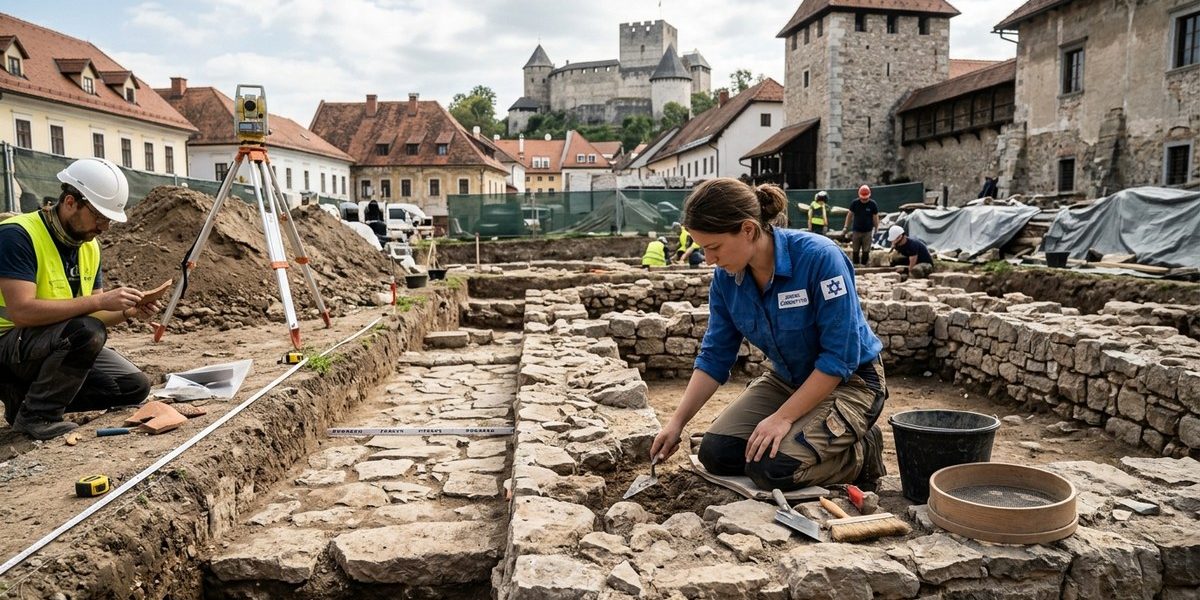
In the summer of 2026, a routine construction project in the old town of Celje, Slovenia, turned into something extraordinary. Workers digging foundations for a new municipal building hit a layer of medieval stonework. Within hours, archaeologists from the University of Ljubljana were on site. By the end of the week, they had confirmed the existence of a previously unknown Jewish quarter, buried under centuries of soil and modern development. This is the story of that find and what it means for our understanding of Jewish life in medieval Central Europe.
The 2026 Celje excavation uncovered the foundations of a medieval Jewish quarter, including a synagogue, a mikvah, and several homes. This site provides the first physical evidence of a thriving Jewish community in Celje that existed from the 13th century until the expulsion of 1496. The discovery reshapes our understanding of Jewish settlement patterns in Slovenia.
What the Diggers Found Under Celje
The site sits near the Savinja River, just outside the medieval city walls. This location was a surprise. Most historical records suggested Celje’s Jewish population lived closer to the main square. The excavation team, led by Dr. Mateja Kralj, found a dense cluster of stone foundations spanning roughly half an acre.
The most important discovery was the synagogue. Its base measured about 40 feet by 25 feet, with a clear eastern orientation. The team found fragments of plaster with faint traces of blue paint, which suggests the interior was decorated. Next to the synagogue, they uncovered a small stone basin with a drainage channel. This was almost certainly a mikvah, a ritual bath. Finding a mikvah outside of a major Jewish center like Maribor or Ljubljana is rare. It tells us the community in Celje was large enough and observant enough to build one.
Why This Discovery Matters for Jewish History
For years, the story of Jews in medieval Slovenia was written mostly from tax records and legal documents. We knew Jews lived in Celje, but we had no physical proof of their daily lives. The Celje Jewish Quarter archaeological discovery 2026 changes that.
Here is what the artifacts are telling us:
- Household goods: Pottery shards, a bronze cooking pot, and glass fragments from drinking vessels show a community with access to trade networks. Some of the pottery matches styles found in Venice, suggesting active commerce.
- Personal items: A silver ring with a Hebrew inscription, several bone buttons, and a child’s leather shoe. These objects make the past feel human. Someone wore that ring. A child ran through these streets.
- Tools of trade: Iron tools, including shears and a scale, indicate that some residents were artisans and merchants. This matches historical records that mention Jewish moneylenders and traders in Celje.
“We always knew the Jewish community in Celje existed on paper,” says Dr. Kralj. “But holding a child’s shoe from 1450 makes it real in a way a tax list never can. These were families living, working, and praying here.”
A Timeline of Jewish Life in Celje
To understand the significance of this find, it helps to know the broader story. Here is a timeline of Jewish presence in the region:
| Period | Event | Evidence |
|---|---|---|
| 13th century | First Jewish settlers arrive in Celje | Mentioned in city charters |
| 1300s | Community grows, builds synagogue | New 2026 excavation confirms |
| 1400s | Jewish merchants trade with Venice | Venetian pottery found on site |
| 1496 | Expulsion of Jews from Celje and Ljubljana | Historical decree |
| 1500s onward | Quarter abandoned, built over | No further records |
| 2026 | Accidental discovery during construction | Synagogue and mikvah found |
The expulsion of 1496 was part of a larger pattern across the Habsburg territories. Jewish communities in Styria, Carinthia, and Carniola were forced to convert or leave. The Celje quarter was abandoned and eventually forgotten. Now, over 500 years later, it has reemerged.
How Archaeologists Worked on the Site
The excavation was a race against time. The construction project could not wait forever. The team used a careful process to extract as much data as possible. Here are the steps they followed:
- Initial survey: Ground-penetrating radar mapped the underground structures before any digging started. This told them where to focus.
- Trench excavation: They dug three main trenches across the site. Each trench was 5 feet wide and up to 10 feet deep.
- Layer documentation: Every layer of soil was photographed, measured, and sampled. They found four distinct building phases, showing the quarter grew over time.
- Artifact recovery and cataloging: Each object was given a unique ID. Pottery was reconstructed in the lab. Metal items went through conservation to stop rust.
- Public presentation: The team set up a small viewing platform so the public could watch the dig in progress. This generated local interest and support.
What the Mikvah Tells Us
The ritual bath is the star of the show. It was built from local limestone, lined with waterproof plaster, and fed by a spring. The basin is about 6 feet deep. Steps lead down into the water. This design matches mikvahs found in other Central European Jewish communities.
A mikvah requires a specific amount of “living water” (mayim chayim), usually from a natural source. The fact that the Celje community built one suggests they had a resident rabbi or at least a trained community member who could oversee its construction. This was not a temporary settlement. This was a permanent, organized community.
The discovery also raises questions. Where did the community bury their dead? The team has not found a cemetery yet. Local historians are now searching land records from the 1400s to find the likely location. That may be the next big discovery.
Common Misconceptions About Medieval Jewish Life
This find helps correct several misunderstandings. I have put together a table to clarify the facts.
| Misconception | Reality from the Celje Dig |
|---|---|
| Jewish quarters were always ghettos | The Celje quarter was open, near the river, with access to the city. No wall surrounded it. |
| Jews only worked as moneylenders | The tools found show artisans, merchants, and tradespeople lived here. |
| Jewish communities were isolated | The Venetian pottery shows trade connections. They were part of a wider economy. |
| All medieval synagogues were large buildings | This one was modest, fitting a small but devoted congregation. |
How You Can Visit the Celje Jewish Quarter Site
The excavation is ongoing, but the site is already open to the public on limited days. If you are planning a trip to Slovenia, here is what you need to know.
The site is located at the corner of Linhartova ulica and the riverbank. It is a 10 minute walk from Celje’s main railway station. The local museum, the Museum of Recent History Celje, has a small exhibit of the artifacts found so far. They plan to build a permanent display by late 2027.
For those interested in the broader context of Jewish heritage in the region, you can also read about the Rediscovering the Jewish Quarter of Ptuj Through Archaeological Finds or learn about The Hidden Synagogues of Medieval Ljubljana: Uncovering Lost Jewish Architecture. These sites together paint a fuller picture of Slovenian Jewish history.
What Happens Next for the Artifacts
The most valuable items will go to the National Museum of Slovenia in Ljubljana for long term conservation. The pottery and everyday tools will stay in Celje. The city government has already committed funds to build a small on site museum pavilion. This will allow visitors to see the foundations of the synagogue and mikvah in their original location.
The team is also working with the Jewish Community of Slovenia to ensure the site is treated with respect. They have consulted with rabbis about the proper handling of any human remains, should they be found. So far, no burials have been uncovered.
The Bigger Picture for Jewish Heritage Travel
This discovery puts Celje on the map for anyone interested in Jewish heritage tourism. Slovenia already has well preserved Jewish sites in Maribor and Ljubljana. Now Celje offers something different: an active dig where history is being uncovered in real time.
If you are a history enthusiast or an amateur archaeologist, this is a rare opportunity. You can stand at the edge of a trench and see a 500 year old street. You can watch conservators clean a bronze pot that someone used to cook dinner in the 1400s. That connection to the past is powerful.
For more context on the broader history of the region, you might enjoy reading about How Jewish Traders Shaped Slovenia’s Medieval Economy or The Great Expulsion of 1515: When Jews Were Forced to Leave Slovenian Lands. These articles help frame the Celje find within the larger story of Jewish life in Slovenia.
A Discovery That Keeps Giving
The Celje Jewish Quarter archaeological discovery 2026 is not just about old stones. It is about restoring a part of history that was almost lost. For centuries, this community existed only in faded documents. Now it has a physical presence again. The synagogue walls, the ritual bath, the child’s shoe all of it tells a story of resilience.
If you are planning a cultural trip to Slovenia, add Celje to your list. Walk down to the river. Stand where the synagogue once stood. And remember that history is not always in museums. Sometimes it is right under our feet.