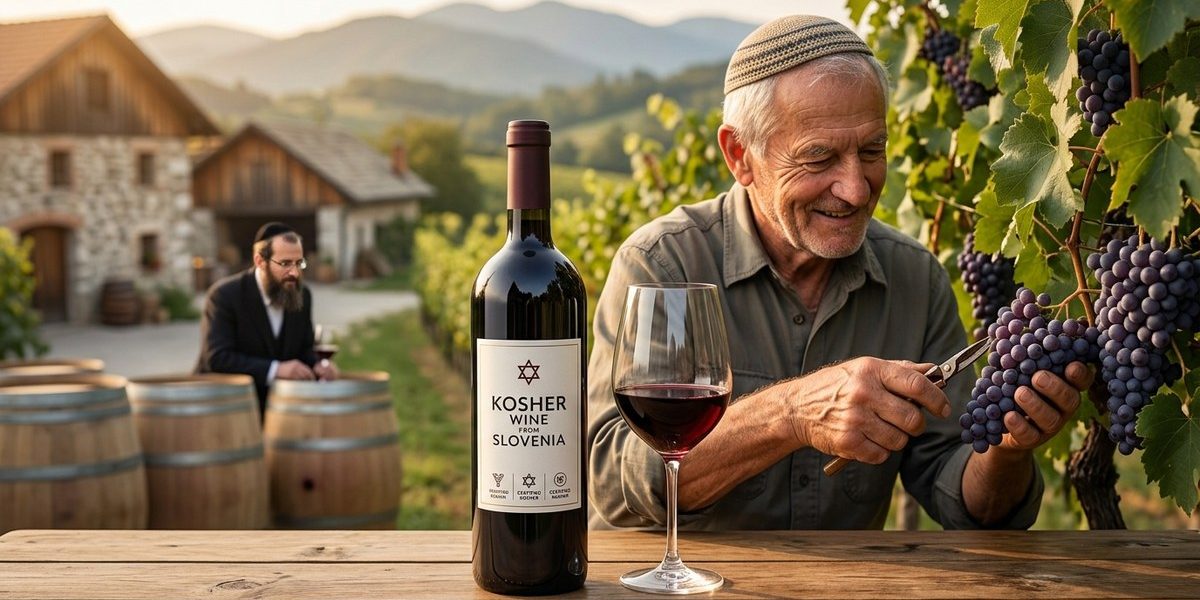
Slovenia is not the first place that comes to mind when you think of kosher wine. Names like Israel, France, Italy, and California usually dominate the conversation. But something is shifting in the world of wine. Over the last few years, a small but passionate group of Slovenian winemakers has started producing certified kosher wines. They are blending Old World techniques with ancient Jewish laws, and the results are turning heads. If you are a wine enthusiast or a Jewish consumer looking for something new, Slovenia deserves a spot on your radar. The country’s rolling hills, mineral-rich soils, and cool climate create ideal conditions for grapes that work beautifully within kosher guidelines. And the winemakers here are not cutting corners. They are learning the rules of kashrut, bringing in mashgichim, and bottling wines that can stand proudly on any Shabbat table.
Slovenian winemakers are producing high quality kosher wine by adapting local grape varieties like Rebula and Šipon to meet strict kashrut standards. Certification involves full time supervision from crush to bottle, with options for mevushal and non mevushal production. This small but growing movement offers Jewish consumers access to unique European terroir and gives industry professionals a fresh sourcing opportunity.
Why Slovenia Is Becoming a Kosher Wine Destination
Slovenia sits at a crossroads of climate and culture. It borders Italy, Austria, Hungary, and Croatia. Its wine regions benefit from both Alpine and Mediterranean influences. The result is a diverse landscape where white grapes thrive in limestone soils and red grapes ripen under warm Adriatic breezes.
For years, Slovenian wine stayed mostly local. Exports were limited. But that changed around the early 2020s. Wine critics started noticing the quality coming out of regions like Goriška Brda, Vipava Valley, and Štajerska. Today, in 2026, Slovenian wine appears on more international lists than ever before.
The kosher angle adds another layer. Jewish travelers and expats in Central Europe began asking local producers if they could make kosher batches. A few said yes. Then a few more. Now there is a small but reliable network of kosher certified wines coming out of Slovenia. For the Jewish consumer, this means access to a terroir that was previously unavailable. For the industry professional, it represents a new sourcing opportunity in a market that values authenticity and craft.
Understanding how kashrut works in a winery setting is the first step. For a deeper look at how dietary laws apply across different foods, check out this guide on how kashrut shapes every meal. The same principles that govern your kitchen also govern the winery, just with some unique twists.
What Exactly Makes Wine Kosher?
Wine holds a special place in Jewish law. It is used for kiddush, for weddings, for holidays. Because of this, the rules around kosher wine are more detailed than those for many other foods. The process is not complicated, but it requires attention.
Here are the three core requirements that Slovenian winemakers must follow:
-
Only kosher ingredients may be used. This means the grapes must be grown without certain restrictions, but more importantly, any additives must be certified kosher. Yeast, fining agents, and stabilizers all need kosher certification. Most standard winemaking uses non kosher materials, so the entire ingredient list must be swapped.
-
The wine must be handled by Shomer Shabbat Jews from crush to bottle. If a non Jewish winemaker touches the wine without a mashgiach present, the kosher status can be compromised. This is the biggest operational shift for Slovenian producers. They must either employ Jewish staff or work under constant supervision. Many choose the supervision route.
-
The equipment must be koshered before use. If a winery also produces non kosher wines, all tanks, hoses, pumps, and bottling lines must be thoroughly cleaned and koshered under rabbinic supervision. Some wineries dedicate separate tanks just for kosher production to avoid the hassle.
These rules sound strict, and they are. But they are also straightforward. Once a winery sets up the right workflow, making kosher wine becomes part of the routine.
The Role of Mevushal in Slovenian Production
One of the biggest decisions a kosher winery faces is whether to make mevushal or non mevushal wine. Mevushal means the wine has been flash pasteurized or boiled. This changes the wine’s status so that it can be handled by non Jewish workers and still remain kosher. Non mevushal wine must be handled exclusively by Shomer Shabbat Jews at all times.
For a small Slovenian winery that relies on local seasonal staff, mevushal is often the practical choice. But some producers worry about the impact on flavor. Here is a breakdown of the differences.
| Aspect | Mevushal Wine | Non Mevushal Wine |
|---|---|---|
| Handling rules | Can be handled by any worker after pasteurization | Must be handled only by Shomer Shabbat Jews |
| Flavor impact | Some fruit character may be reduced | Full flavor profile preserved |
| Best for | Restaurants, hotels, large events | Personal use, fine dining, collectors |
| Certification complexity | Lower, because supervision is less constant | Higher, because a mashgiach must be present at all times |
| Shelf life | Extremely stable, resists spoilage | Normal aging potential |
Slovenian winemakers tend to prefer non mevushal for their premium labels. They want the wine to express the terroir fully. For entry level or export focused wines, they sometimes choose mevushal to simplify logistics. Both styles have their place, and both can be excellent.
Grape Varieties and Terroir in Kosher Production
Slovenia is home to dozens of native grape varieties. Some are well known internationally. Others are almost impossible to find outside the country. For kosher production, the winemakers tend to focus on varieties that respond well to minimal intervention.
- Rebula (Ribolla Gialla). A white grape with high acidity and citrus notes. It ages beautifully and holds up well to kosher winemaking techniques.
- Šipon (Furmint). The same grape used in Hungarian Tokaji. It produces dry wines with floral and mineral character.
- Modra Frankinja (Blaufränkisch). A red grape with dark fruit and spice. It is one of the few reds that thrives in Slovenia’s cooler regions.
- Laški Rizling (Welschriesling). Not related to true Riesling, but crisp and aromatic. A reliable choice for white kosher blends.
- Cabernet Sauvignon and Merlot. These international varieties grow well in the coastal Primorska region and are used for kosher red blends.
The limestone and marl soils of the Vipava Valley give the wines a distinct mineral backbone. This is the same kind of terroir that makes wines from Burgundy and Friuli so sought after. Slovenian kosher wines offer that same sense of place.
How Slovenian Winemakers Achieve Certification
The path to certification is not something a winery can do overnight. It requires planning, investment, and a willingness to learn. Most Slovenian wineries start by contacting a kosher certification agency. The two most common ones operating in Europe are the Orthodox Union and OK Kosher. Some wineries also work with the Badatz or the local rabbinate if there is one nearby.
A mashgiach visits the winery before the harvest to inspect the equipment and ingredients. Then, during the harvest and fermentation, a mashgiach is present on site to supervise. For smaller wineries, this can be expensive. But many producers find that the premium they can charge for kosher wine offsets the cost.
“The first year was the hardest. We had to learn a completely new way of working. But once we understood the rhythm, it became second nature. Now we look forward to the kosher harvest. It is a chance to make something sacred.”
— A winemaker from the Goriška Brda region, speaking about their first kosher vintage in 2023.
The certification must be renewed every year. Each vintage is judged on its own merit. If a winery changes a supplier for yeast or fining agents, the kosher status can be affected. Consistency is key.
Where to Find Kosher Slovenian Wine
Finding kosher wine from Slovenia used to require a direct connection to the winery. That is changing. In 2026, several importers in the United States now carry kosher Slovenian labels. You can find them in specialty kosher wine shops, online retailers, and even some mainstream stores with a kosher section.
If you are traveling in Europe, you can visit the wineries directly. The Vipava Valley and Goriška Brda are both beautiful regions to explore. Many wineries offer tastings by appointment. Some even have guesthouses where you can stay overnight.
For those who want to keep kosher while traveling in Slovenia, here is a helpful resource on can you keep kosher in Slovenia. It covers restaurants, grocery options, and community connections.
The Future of Kosher Wine in Slovenia
The kosher wine movement in Slovenia is still small. But it is growing. More wineries are expressing interest each year. The Jewish community in Slovenia, though small, has become more visible since the revival of Jewish life in the 1990s. That visibility has sparked curiosity among local producers.
There are challenges. The cost of certification is high for a small winery. The need for full time supervision during harvest can be logistically difficult. And the market is still niche. But the quality of the wine speaks for itself. When a Slovenian winemaker puts care into a kosher cuvée, the result is a bottle that can compete with anything from the more established kosher regions.
For the wine enthusiast, this is a chance to taste something rare. For the Jewish consumer, it is an opportunity to support a growing tradition in a part of the world where Jewish life is quietly thriving again. And for the industry professional, Slovenia represents a frontier worth watching.
Raising a Glass to Slovenian Kosher Wine
Next time you are shopping for a bottle for Shabbat or a holiday, look for a Slovenian label. Ask your local wine shop if they carry anything from the Vipava Valley or Goriška Brda. If they do not, request it. The more we ask, the more these wines will become available.
The winemakers of Slovenia are doing something special. They are honoring an ancient tradition with local grapes and modern skill. That combination deserves a place on your table. So go ahead, open a bottle of kosher wine from Slovenia, and taste what happens when a small country takes on a big tradition.