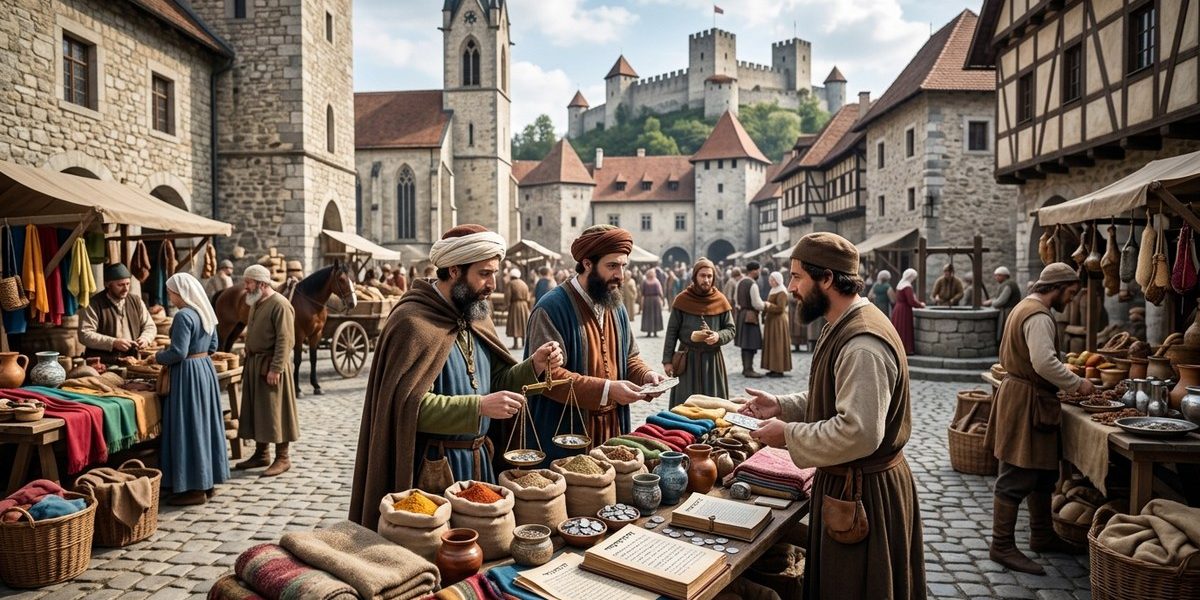
Picture a narrow street in medieval Maribor, the air thick with the smell of spices and salt. A merchant in a long coat negotiates the price of Hungarian copper next to a bolt of Venetian silk. He speaks several languages, keeps meticulous records, and holds a letter of credit from a banker in Vienna. That merchant was Jewish, and he was part of a network that stretched from the Adriatic to the Danube. Jewish traders in medieval Slovenia did not just participate in the local economy. They were essential connectors, financiers, and innovators who helped turn this small region into a vital European trade hub.
Jewish traders in medieval Slovenia served as cross-cultural intermediaries, linking the Venetian, Hungarian, and Germanic economic spheres. They introduced sophisticated credit systems, long-distance trade contracts, and specialized knowledge of luxury goods and metals. Despite frequent legal restrictions and periodic expulsions, their commercial networks persisted for centuries and laid the groundwork for modern Slovenian trade infrastructure.
The Arrival of Jewish Traders in Slovenian Lands
Jewish merchants began appearing in the territory of modern Slovenia as early as the 9th century, following the old Roman trade roads. The Radkersburg and Ptuj regions show traces of early Jewish settlement tied to salt and iron routes. By the 13th century, significant communities had formed in Maribor, Ljubljana, and Celje. These were not isolated ghettos. Jewish traders lived within the city walls, often near the main market square, because their work required proximity to customers and customs houses.
Why did they come to Slovenia? The region sat at the intersection of three major economic zones: the Venetian maritime republic, the Hungarian Kingdom, and the Holy Roman Empire. Jewish traders capitalized on this position. They could move goods like wax, honey, slaves, furs, and wine across borders more efficiently than many Christian merchants, partly because they maintained family and co-religionist networks that provided trusted agents in foreign cities.
Trade Routes and Key Commodities
The backbone of Jewish trade in medieval Slovenia was the route connecting the port of Trieste with the interior. Jewish merchants imported fine textiles from Italy, saffron and other spices, glassware, and paper. In return, they exported Slovenian timber, iron ore from the Karavanke mines, cattle, and, most importantly, mercury from the Idrija mines.
A typical shipment might look like this list:
- Textiles: Flemish woolens and Italian silks, often traded for Slovenian linen.
- Metals: Iron, copper, and mercury destined for arms manufacturing in German cities.
- Spices and dyes: Saffron, pepper, and woad (for blue dye) from Venice.
- Luxury goods: Coral, amber, and precious stones for church vestments and noble jewelry.
- Agricultural products: Wine from Styria, wax for candles, and honey.
Jewish traders did not just move goods. They also moved money. Many acted as moneylenders and pawnbrokers, offering credit to nobles and bishops who needed cash for wars or construction. This role made them indispensable, but also vulnerable.
The Role of Credit and Moneylending
Because canon law forbade Christians from charging interest, Jewish lenders filled a critical gap. They provided short-term loans at moderate rates, typically between 20 and 40 percent annually. The risks were high: default by powerful clients often went unpunished, and Jewish creditors could not always enforce contracts in Christian courts.
Dr. Miriam K. Ben-Zvi, a historian of medieval Jewish commerce at the University of Ljubljana, explains:
“Jewish traders were not just moneylenders. They were venture capitalists of their time. They funded trade expeditions, advanced goods to retailers, and created the first bills of exchange in Slovenian territory. Without their credit networks, the region’s mining and textile industries would have grown much slower.”
Moneylending, however, came with a social cost. It fueled antisemitic stereotypes and provided justification for periodic expulsions. Rulers would invite Jewish traders in during times of economic need, then expel them when the debts became uncomfortable.
A Table of Common Trade Goods and Their Origins
| Good | Origin | Destination | Jewish Role |
|---|---|---|---|
| Salt | Sečovlje salt pans | Hungary, Austria | Trade and transport |
| Iron ore | Kočevje region | Venetian arsenals | Mining investment and export |
| Silk | Venice, Lucca | Nuremberg, Prague | Import and wholesale |
| Wine | Maribor, ptuj | Bohemia, Silesia | Storage and distribution |
| Long pepper | India (via Venice) | Central Europe | Import and credit sales |
| Ash (for glassmaking) | Slovenian forests | Venice, Murano | Collection and shipping |
Challenges and Restrictions
Life for Jewish traders in medieval Slovenia was never easy. They paid higher taxes than Christian merchants, often double or triple rates. They were required to wear distinctive badges or hats, which made them targets for robbery. And they faced periodic legal crackdowns.
Here are three ways these restrictions shaped their business practices:
- Partnership structures: Jewish traders used formal partnerships ( ḥevrā ) to spread risk across multiple families. If one member was expelled, others could carry on the trade.
- Record keeping: They maintained detailed account books in Hebrew script, which gave them a secure, private ledger that local authorities could not easily read.
- Liquidity management: Because they could not own land in many towns, Jewish traders kept most of their wealth in movable goods, coins, and credit notes. This made them able to relocate quickly if needed.
Despite these obstacles, Jewish merchants continued to thrive. In 1377, a Jewish merchant named Mordechai of Ptuj financed the construction of a new bridge over the Drava River in exchange for toll exemptions. Such deals show how deeply embedded they were in the regional economy.
The Legacy of Jewish Commerce in Slovenia
The influence of Jewish traders did not end with their expulsion from most Slovenian lands in 1515. Their commercial methods, including double-entry bookkeeping and formal credit instruments, were adopted by Christian merchants. The trade routes they established continued to be used for centuries. Even after the Jewish community shrank, the economic structures they built persisted.
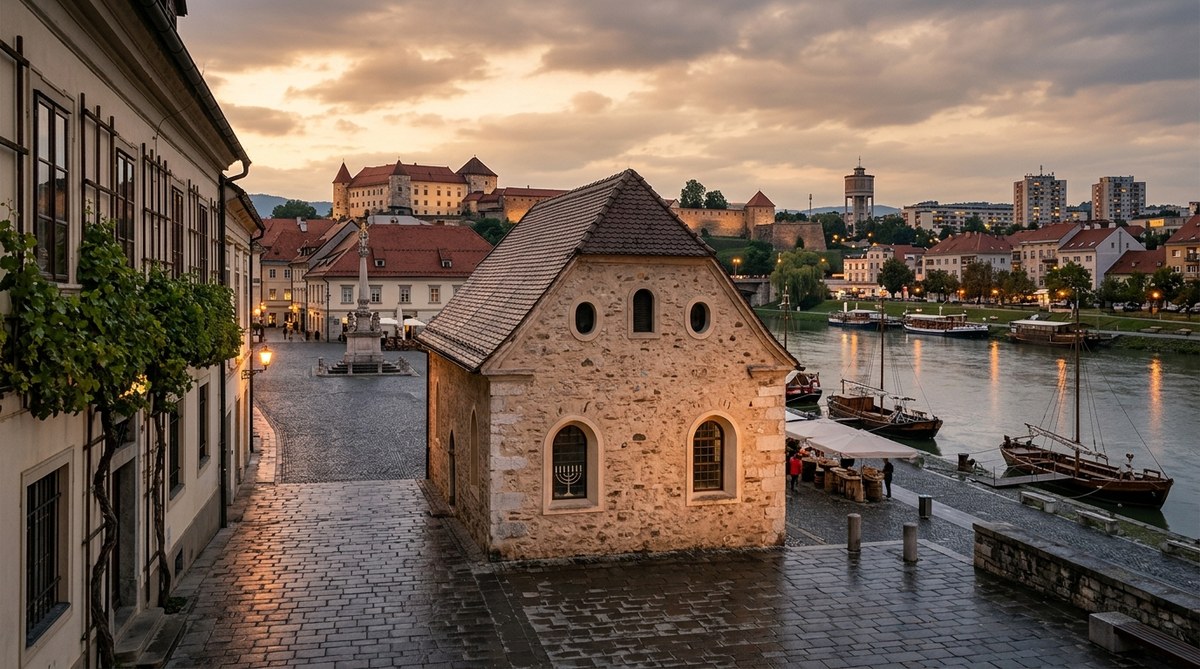
Today, visitors to Maribor can see the old Jewish quarter, with its synagogue and former market streets. The synagogue now serves as a museum, and cultural center. To understand how Jewish life evolved after the medieval period, you might enjoy From Emancipation to Integration: Jewish Life in 19th Century Slovenia. And for a look at the physical spaces they left behind, check out Rediscovering the Jewish Quarter of Ptuj Through Archaeological Finds.
Looking Forward: The Resonance of Medieval Trade in Today’s Slovenia
The story of Jewish traders in medieval Slovenia is not just a historical curiosity. It shows how a minority community, operating under constant pressure, can become an engine for economic growth. Their cross-border networks, financial innovations, and willingness to take risks created a template for international trade that Slovenia still benefits from. Next time you walk through the old market square in Ljubljana or Maribor, remember that the cobblestones were worn smooth by the feet of Jewish merchants carrying goods and ideas across a continent. Their legacy is woven into the very fabric of Slovenian commerce.