The story of Slovenia’s Jewish community under Yugoslav socialism is not one of quiet survival but of surprising renewal. After the Holocaust erased all but a handful of Slovenian Jews, the survivors returned to a homeland that had become part of the newly formed Socialist Federal Republic of Yugoslavia. Unlike other communist states that suppressed religious life, Tito’s Yugoslavia allowed religious communities to operate within strict boundaries. This created a narrow but real space where a tiny Jewish population could rebuild its institutions, celebrate its traditions, and even grow. By the 1970s, the community had more than doubled from its postwar low. Today, looking back from 2026, we can see how the socialist years laid the foundation for the vibrant, modern Jewish life that exists in Slovenia today.
Under Yugoslav socialism, Slovenia’s Jewish community rebuilt from fewer than 100 survivors to several hundred members by using the state’s unique religious policies. They maintained a kosher kitchen, ran Sunday schools, hosted international festivals, and preserved Holocaust memory. This period became a bridge between near destruction and the community’s modern revival after Slovenia’s independence.
A Unique Path for a Small Community
Before World War II, around 1,500 Jews lived in the territory of what is now Slovenia. Most were Ashkenazi, with communities in Ljubljana, Maribor, and smaller towns like Ptuj and Lendava. The war reduced that number to fewer than 150. Those who returned after 1945 found their synagogues damaged, their cemeteries neglected, and their way of life shattered. Yet they also found something unexpected: a socialist state that, unlike the Soviet Union or its Eastern Bloc neighbors, did not outlaw religious practice outright.
Yugoslavia’s brand of socialism, especially after its break from Stalin in 1948, allowed for a degree of religious and cultural autonomy. The 1946 constitution guaranteed freedom of conscience and the right to religious practice, though it also mandated that religious communities must register with the state. Jewish survivors quickly organized themselves. In 1945, they formed the Jewish Religious Community of Slovenia (Jevrejska verska občina Slovenije) and registered it under the new laws. This gave them legal standing to own property, receive state subsidies, and hold public gatherings.
The Foundations of Survival: Legal and Cultural Protections
The Yugoslav system officially separated religion from the state, but it did not ban religious organizations outright. Instead, it controlled them through registration and oversight. For Slovenia’s Jews, this meant they could:
- Rent or own buildings for worship and community events
- Publish newsletters and educational materials
- Receive financial support from the national Jewish federation based in Belgrade
- Maintain ties with international Jewish organizations such as the American Jewish Joint Distribution Committee (JDC)
- Organize cultural festivals, lectures, and concerts
The state also funded the restoration of some Jewish heritage sites, particularly cemeteries and memorials. While the government pushed a narrative of “brotherhood and unity” among all Yugoslav peoples, it allowed Jewish identity to exist as both a religious and ethnic category. This was a critical distinction. In many other communist countries, Jewishness was reduced to a nationality that had to be renounced. In Yugoslavia, Jews could register as belonging to the “Jewish nation” on their census forms, which helped them receive proportional representation in politics and culture.
A key example of this protection was the 1954 agreement between the Yugoslav government and the Jewish community. The government recognized the community as a self-governing religious body and granted it tax exemptions and import licenses for kosher food. This deal, though limited, was far more generous than what Jews experienced in, say, Romania or Hungary at the same time.
Building Community Life in Ljubljana and Maribor
Ljubljana became the heart of the postwar Jewish revival. The community rented a small building near the center that served as a synagogue, a classroom, and a social hall. In the 1960s, with state assistance and donations from the JDC and Israeli institutions, they purchased a larger property on Križeva ulica. That building, now the site of the modern Jewish Cultural Center, housed a permanent synagogue, a library, a kosher kitchen, and meeting rooms. By 1970, the community had grown to about 200 members, almost double the 1950 number.
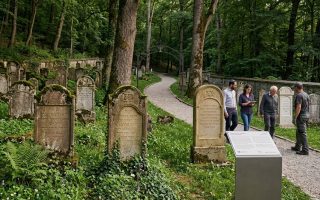
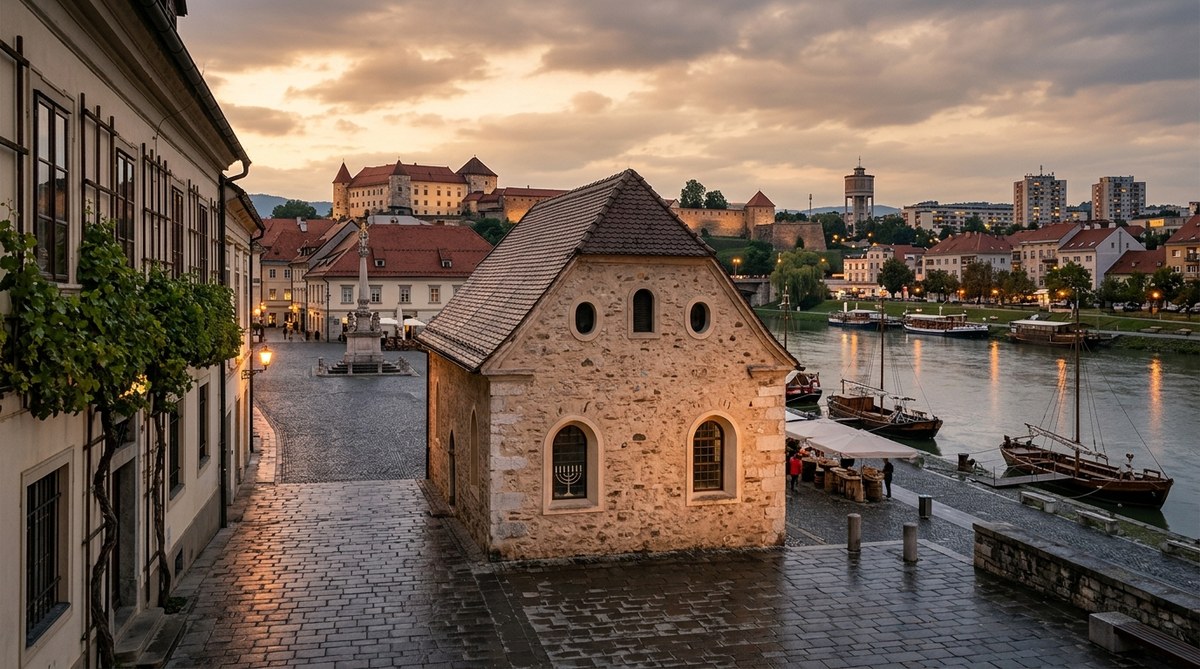
Maribor, once home to Slovenia’s largest prewar Jewish community, also revived. Although the old synagogue on Slomškov trg had been damaged and later converted into a museum, the community established a small prayer room in a private apartment. They worked with local authorities to maintain the ancient Jewish cemetery on Cesta XIV. divizije. Every year, they held Holocaust remembrance ceremonies that drew non-Jewish neighbors as well.
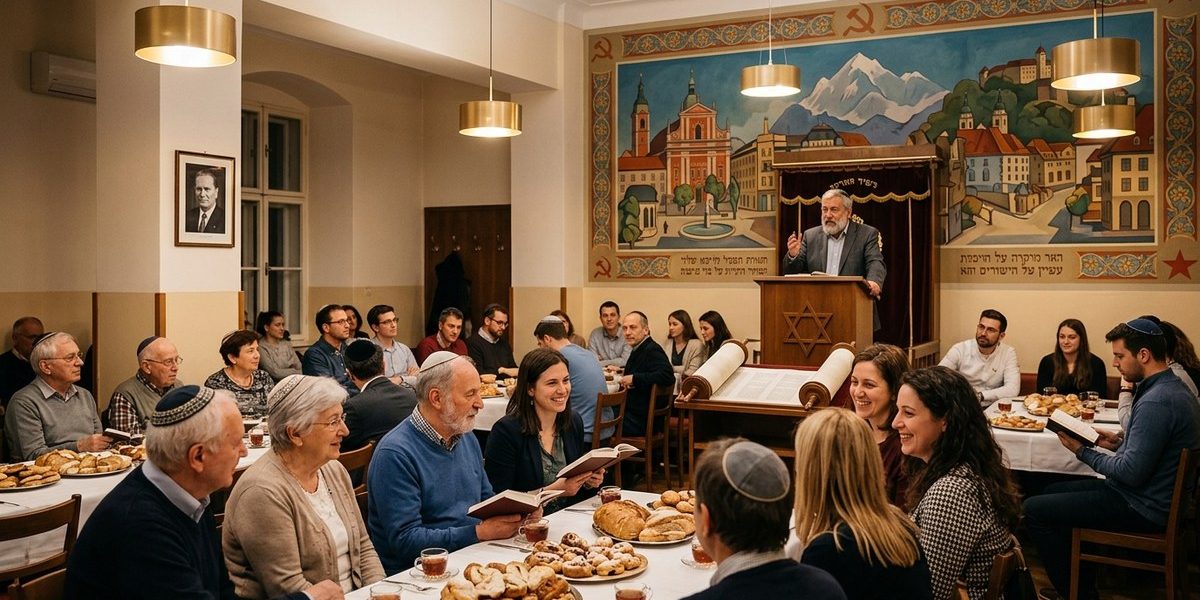
Life in these communities revolved around the Jewish calendar. They celebrated Rosh Hashanah and Yom Kippur with a visiting rabbi from Zagreb, because Slovenia never had a permanent resident rabbi after the war. They gathered for Hanukkah parties where children lit candles and received small gifts. Purim meant costumes and hamantaschen baked in the community kitchen. These events, though modest, created a sense of belonging that kept Jewish identity alive.
Education, Culture, and Intellectual Contributions
Formal Jewish schooling was not permitted under socialism. But the community found creative ways to teach the next generation. They held Sunday morning classes where children learned Hebrew songs, Jewish history, and the meaning of holidays. Older members taught younger ones how to read from the Torah scrolls that had survived the war. The community also ran a summer camp near Bled, where Jewish children from all over Yugoslavia gathered for two weeks of sports, swimming, and Jewish learning.
Intellectually, Slovenian Jews made significant contributions to the broader culture. Writers, musicians, and academics who were Jewish played important roles in Yugoslav society, even if they did not always highlight their background. For example, the philosopher and literary critic https://jewish-community.si/what-role-did-jewish-intellectuals-play-in-slovenian-academic-life/ argued for pluralism in Marxist thought. The community also produced its own periodical, “Juden in Slowenien” (a bilingual German and Slovenian publication), which covered local news and articles on Jewish history. These efforts ensured that the community was not isolated; they engaged with the wider world through literature, music, and art.
How the Socialist System Balanced Tradition and Modernity
To understand what made Yugoslavia different, it helps to compare its approach to that of other communist countries during the same period.
| Aspect | Yugoslavia | Soviet Union | Other Eastern Bloc |
|---|---|---|---|
| Religious practice | Permitted but regulated | Heavily restricted; synagogues closed | Restricted; limited state recognition |
| State antisemitism | Rare, official policy opposed it | Periodic state-led campaigns (e.g., Doctor’s Plot) | Mixed; some states allowed, others suppressed |
| Emigration to Israel | Largely allowed after 1948 | Severely restricted until late 1980s | Limited; some left illegally |
| Community institutions | Recognized, subsidized | Severely limited; many dismantled | Weak, under state control |
| Holocaust memorialization | Supported, though framed within Yugoslav narrative | Erased or minimized | Varied; often suppressed |
This table shows that while Yugoslavia was far from a paradise for Jewish life, it provided a much safer environment than other socialist states. The community could flourish precisely because the state did not seek to destroy it.
Preserving Identity Despite Assimilation Pressures
Despite the legal protections, the community faced powerful pressures to assimilate. The socialist ideology promoted secularism, mixed marriages were common, and the small size of the Jewish population made finding a Jewish partner difficult. By the 1980s, most families had intermarried, and only a minority observed kashrut or Shabbat fully.
The community took deliberate steps to slow this trend. Here is how they worked to maintain their distinct identity:
- They maintained a kosher kitchen in the Ljubljana community center, which prepared meals for holidays and sold kosher meat to members.
- They organized youth summer camps that combined Jewish education with recreation, giving children a positive Jewish experience.
- They hosted international Jewish cultural festivals in Ljubljana, bringing performers and speakers from Israel, the United States, and Western Europe.
- They trained lay leaders to lead services and teach classes, so the community did not depend entirely on visiting rabbis.
- They collected and published oral histories of Holocaust survivors, ensuring that the memory of prewar life was not lost.
These efforts were complemented by the work of individual families. Many parents chose to give their children Hebrew names and taught them prayers at home. Some households kept kosher in a modified way, avoiding pork even if they did not fully separate milk and meat.
“We were always a small boat on a large sea,” recalled Ester Lehman, a community activist who grew up in Ljubljana in the 1960s. “But we learned to navigate by staying close to each other. The state let us have our own space, and we filled it with as much Jewish life as we could. That is what kept us afloat.”
Memory and Memorialization Under Socialism
Yugoslav authorities acknowledged the Holocaust but framed it as part of the broader fascist crimes against all Yugoslav peoples. Jewish specificity was sometimes downplayed. Still, the community succeeded in erecting several memorials. In 1961, they unveiled a plaque at the Ljubljana railway station where Jews had been deported. In Maribor, they worked with the city to restore the old synagogue and turn it into a cultural center that hosted Jewish art exhibits.
The community also participated in national remembrance events. Every year on the anniversary of the Italian armistice (September 8), they joined other Yugoslav citizens in honoring anti-fascist fighters. The Jewish contribution to the partisan movement was especially emphasized. Many of the survivors had themselves been and they took pride in that legacy.
These memorial practices served a double purpose. They kept the memory of the community’s sacrifice alive, and they demonstrated loyalty to the socialist state, which in turn protected the community’s right to exist. It was a delicate balance, but it worked.
The Legacy Today: From Socialism to Independent Slovenia
When Slovenia declared independence in 1991, the Jewish community was small but well organized. It had a building, a membership list, a library, and decades of experience in navigating a mixed secular and religious identity. The transition to democracy brought new freedoms but also new challenges. The community could now invite permanent rabbis, open a Jewish school, and expand its activities without state oversight.
However, the socialist period left a lasting imprint. The community had learned to be self-reliant, to value lay leadership, and to maintain ties with Jewish organizations abroad. These skills proved critical in the 1990s and 2000s as the community rebuilt and eventually grew to include both native Slovenian Jews and newcomers from Israel, the United States, and other countries.
Today, in 2026, the Jewish community of Slovenia numbers around 400 members. It runs a thriving cultural center, hosts interfaith dialogues, and teaches Hebrew and Yiddish classes. Much of that vitality can be traced back to the socialist era, when a handful of survivors refused to let their traditions die.
For researchers and history enthusiasts, the Slovenian example offers a rare case study of Jewish survival under a socialist regime. It shows that even in a system designed to erase religious identity, a determined community can find ways to persist. And it reminds us that resilience often comes from the smallest numbers.
Lessons from a Small but Resilient Community
The story of Slovenia’s Jews under Yugoslav socialism is not just a historical footnote. It holds practical lessons for anyone interested in how minorities can maintain their identity under challenging political systems. The community’s success depended on three factors: a relatively tolerant state, strong internal organization, and support from the global Jewish diaspora.
For modern communities in the United States or elsewhere, the Slovenian example shows that size does not determine impact. A community of a few hundred people can preserve traditions, educate children, and contribute to the wider society. The key is to stay connected, both internally and with the larger Jewish world.
If you want to learn more about the paths this community took after socialism ended, read about Or explore how they have worked with other communities through Each of these stories builds on the foundation laid during the socialist years.
The next time you visit Ljubljana, stop by the Jewish Cultural Center on Križeva ulica. Look at the photographs on the wall. You will see faces from the 1950s, 1960s, 1970s people who could have given up but chose to stay. Their determination is what allowed Slovenia’s Jewish community to thrive under Yugoslav socialism and to continue thriving today.