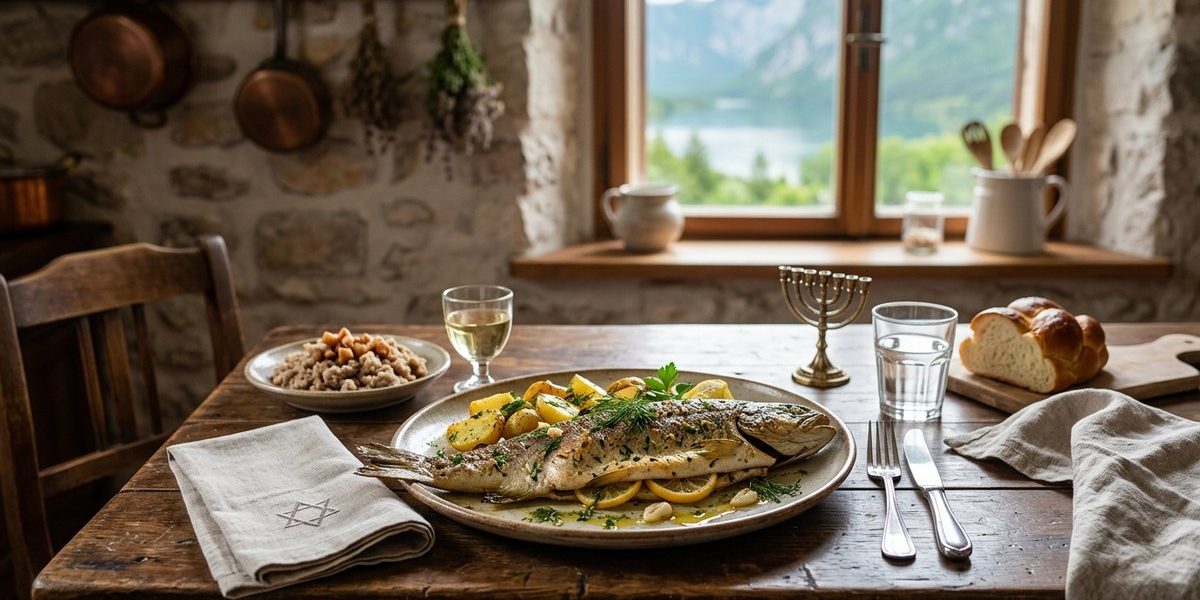
Lake Bled glitters under the Julian Alps. The Sava River winds through vineyards and forests. In these clear, cold waters lives the soul of a little known Jewish culinary tradition. For centuries, Slovenian Jewish families have relied on freshwater fish as the centerpiece of their Shabbat and holiday tables. While gefilte fish made from carp or pike is common across Eastern Europe, the Slovenian version carries a distinct local character. It is not a substitute or a compromise. It is a choice born from geography, resourcefulness, and a deep respect for the land.
Freshwater fish like pike, carp, and trout became essential in Slovenian Jewish kitchens because of the region’s abundant rivers and lakes. The resulting gefilte fish style is lighter, herbier, and often poached in a broth infused with local white wine. This article walks you through the historical background, a step by step recipe, and common pitfalls to avoid so you can recreate this unique dish at home in 2026.
Why Freshwater Fish Became a Slovenian Jewish Staple
Slovenia sits at a crossroads of Central Europe. Its rivers and lakes have provided protein for centuries. Jewish communities in towns like Maribor, Ljubljana, and Ptuj had limited access to the sea, but they had the Sava, the Drava, the Soča, and the sparkling waters of Lake Bled. Freshwater fish were abundant, affordable, and could be caught year round.
Kashrut (Jewish dietary laws) requires that fish have fins and scales. Nearly all freshwater fish in Slovenia satisfy that requirement. Carp, pike, perch, and trout are all kosher. This made them ideal for festive meals. Unlike meat, fish does not require the same separation from dairy, giving home cooks more flexibility in menu planning.
Over time, Slovenian Jewish cooks developed their own style of preparing these fish. They borrowed local techniques like simmering in a potika style broth, using white wine from the Štajerska region, and adding fresh herbs like lovage and dill that grew wild in the countryside. The result was a gefilte fish that tasted of its place.
The Local Catch: Fish of the Slovenian Rivers
- Pike (ščuka): Lean, firm flesh that holds together well in gefilte fish. Slightly sweet.
- Carp (krap): Classic Ashkenazi choice. Rich flavor, higher fat content. Often used for gefilte fish.
- Trout (postrv): Delicate and mild. Less traditional for gefilte but used in simpler poached dishes.
- Perch (ostriž): Flaky and mild. Good for lighter broths.
A Slovenian Jewish Gefilte Fish Recipe for 2026
This recipe honors the traditions of Slovenian Jewish grandmothers. It uses pike and carp together for a balanced texture. The broth gets its depth from local carrots, parsnips, and a splash of dry Riesling.
Ingredients
For the fish mixture:
– 1 lb pike fillet, skinned and boned
– 1 lb carp fillet, skinned and boned (or use extra pike if carp is unavailable)
– 1 medium onion, grated
– 2 large eggs
– 1/3 cup matzah meal (or fine breadcrumbs for a non Passover version)
– 2 tablespoons chopped fresh dill
– 1 tablespoon chopped fresh parsley
– 1 teaspoon salt
– 1/2 teaspoon white pepper
– 1/4 cup ice water
For the poaching broth:
– 2 carrots, sliced
– 1 parsnip, sliced
– 1 onion, quartered
– 2 celery stalks, chopped
– 1 cup dry white wine (Slovenian Riesling or Sauvignon Blanc)
– 6 cups water or fish stock
– 1 bay leaf
– 5 black peppercorns
– 1 teaspoon salt
– Fresh dill sprigs
Step by Step Instructions
-
Prepare the fish. Cut the fillets into chunks. Pass them through a meat grinder with a medium die, or pulse in a food processor until coarsely ground. Do not overprocess; you want some texture.
-
Mix the forcemeat. In a large bowl, combine the ground fish, grated onion, eggs, matzah meal, dill, parsley, salt, and white pepper. Stir gently. Add the ice water and mix until the mixture holds together. Let it rest in the fridge for 30 minutes.
-
Shape the quenelles. Wet your hands with cold water. Shape the mixture into oval patties about 3 inches long and 1 inch thick. Place them on a parchment lined tray.
-
Build the broth. In a wide pot, combine the carrots, parsnip, quartered onion, celery, wine, water, bay leaf, peppercorns, and salt. Bring to a gentle boil, then reduce to a simmer.
-
Poach the fish. Carefully lower the fish patties into the simmering broth. They should be mostly submerged. Cover the pot and cook on low heat for 45 minutes. Do not let it boil hard, or the fish will break apart.
-
Cool and serve. Using a slotted spoon, transfer the gefilte fish to a serving dish. Strain the broth and reserve it. Let the fish cool to room temperature. Serve with horseradish and a spoonful of the jellied broth (it will set as it cools). Garnish with fresh dill.
You can make this dish a day ahead. The flavors meld overnight, and the broth sets into a delicate aspic. This is common in Slovenian Jewish households, where Shabbat preparations begin on Thursday.
Common Mistakes and How to Avoid Them
| Mistake | Why It Happens | How to Fix It |
|---|---|---|
| Fish mixture turns out dry | Too much matzah meal or overcooking | Use the ice water and do not boil. Add an extra egg if needed. |
| Gefilte fish falls apart in the broth | Mixture is too wet or broth is boiling | Chill the mixture well. Keep broth at a bare simmer. |
| Flat flavor | Not enough salt or herbs | Taste the mixture before shaping. Season generously. |
| Broth is cloudy | Boiling disrupts sediment | Always start with cold liquid and bring to a gentle simmer. |
“My grandmother always said the secret is in the wine. Slovenian Jews didn’t use sugar like Poles. We used a dry white wine and fresh lovage from the garden. That is the taste of home.” — Mira Levič, descendant of a Maribor Jewish family, interviewed in 2024.
Pairing Your Slovenian Jewish Fish Dish
This gefilte fish pairs beautifully with a chilled glass of Slovenian Riesling. The wine’s acidity cuts through the richness and echoes the herbal notes. For a non alcoholic option, serve with sparkling water and a slice of lemon.
On the side, consider a salad of grated carrots and apples with a light vinaigrette. The crunch contrasts with the soft fish. Many Slovenian Jewish families also serve pickled beets or a simple cucumber salad.
If you are planning a full Shabbat dinner, this dish works well as a first course. Follow it with a hearty cholent made with Slovenian beans and smoked beef. You can explore more about how Cholent meets Slovenian stew in our guide to adapting slow cooked classics.
Why Freshwater Fish Deserve a Second Look
Many home cooks reach for salmon or whitefish when making gefilte fish. That is fine, but you miss the story. Using pike and carp connects you to a lineage of resourceful cooks who turned local ingredients into something sacred. The rivers of Slovenia are not just scenic backdrops. They are living pantries that have fed Jewish communities for half a millennium.
This 2026, try stepping away from the supermarket fillets. Visit a fishmonger who sources from clean inland waters. Or, if you are lucky, catch your own. The effort changes the dish. You taste the terrain.
For more on the cultural context of Slovenian Jewish life, read about how Slovenian Jewish families keep Passover traditions alive today. And if you are curious about other local ingredients, see 5 Slovenian Ingredients That Elevate Classic Jewish Dishes.
From Savinja to Your Shabbat Table
The next time you shape a gefilte fish patty, imagine the brown trout swimming in the Soča or the carp gliding through Lake Cerknica. That quiet, persistent life in the water is what made Slovenian Jewish cooking possible. It still is.
Try this recipe for your next holiday or family gathering. Share it with friends who think gefilte fish is just a jar on a shelf. Show them it can be delicate, fragrant, and deeply tied to a place. The rivers of Slovenia are waiting. All you need is a pot, some patience, and a taste for history.