When you picture medieval Slovenia, what comes to mind? Perhaps the Julian Alps, the old town of Ljubljana, or the vineyards of Goriska Brda. But there is another layer to this history, one that glitters with the skill of Jewish goldsmiths. For centuries, these artisans worked in cities like Maribor and Ptuj, creating objects of beauty and faith. Their story is not just about metal and gems. It is about survival, cultural exchange, and the very shaping of Slovenian identity. This legacy, often overlooked, deserves a closer look.
Medieval Jewish goldsmiths in Slovenia were not peripheral figures. They were central to the region’s economic and artistic life. Their techniques, from filigree to enamel work, influenced local guilds and produced some of the finest religious and secular metalwork in Central Europe. Understanding their craft helps us see a more complete picture of Slovenian history.
The Medieval Jewish Presence in Slovenian Lands
Jewish communities in Slovenia date back to at least the 13th century. They settled in towns along major trade routes. Maribor, Ptuj, and Ljubljana all had vibrant Jewish quarters. These were not isolated ghettos. They were active centers of commerce and culture.
Jewish goldsmiths held a special position. They were often the only craftsmen allowed to work with precious metals outside the strict guild system. This gave them a unique freedom, but also made them vulnerable. Their success depended on the goodwill of local rulers and the Church.
The work of these goldsmiths was in high demand. They made:
- Ritual objects for synagogues, such as Torah crowns and finials
- Chalices and reliquaries for Christian churches
- Jewelry for noble families
- Coins and seals for local authorities
Their skill was legendary. Some say the finest silver work in 14th-century Slovenia came from Jewish hands.
Techniques That Defined an Era
What made the work of medieval Jewish goldsmiths in Slovenia so special? It was their mastery of several key techniques. These methods were passed down from father to son, often kept as family secrets.
Here are three core processes they used:
- Filigree work: Thin wires of gold or silver were twisted and soldered into delicate patterns. This created lace-like designs that were light and airy. It was a signature style.
- Niello inlay: A black metallic alloy was applied to engraved metal. The contrast between the dark niello and the bright silver or gold made inscriptions and images pop. This was popular for decorative plates and weapon fittings.
- Repoussé and chasing: Sheets of metal were hammered from the back to create raised designs. The front was then refined with chasing tools. This technique gave depth to ceremonial objects.
These techniques were not unique to Jewish artisans, but their execution was often superior. They brought a precision that came from generations of practice.
A Table of Craft: Techniques and Their Uses
To understand the range of their work, look at this breakdown of common techniques and where they were applied.
| Technique | Description | Common Use | Mistake to Avoid |
|---|---|---|---|
| Filigree | Twisted wire patterns | Torah shields, earrings | Overheating the metal, causing wires to melt |
| Niello | Black alloy inlay | Signet rings, belt buckles | Applying niello too thickly, creating a rough surface |
| Repoussé | Hammered relief from the back | Chalices, book covers | Hammering too hard, causing the metal to tear |
| Granulation | Tiny gold spheres fused to a surface | Pendants, small amulets | Uneven heat distribution, causing spheres to cluster |
| Engraving | Cutting lines into the metal | Ceremonial cups, seals | Using a dull tool, which leaves jagged edges |
Each technique required a steady hand and a deep understanding of materials. A mistake could ruin a piece that took weeks to make.
The Economic Role of Jewish Goldsmiths
These artisans were not just artists. They were also bankers and moneylenders. This dual role was common in medieval Europe. Christians were forbidden from lending money with interest, but Jews were not. A goldsmith could take raw gold as collateral, craft it into an object, and sell it for a profit. This made them essential to the local economy.
In Maribor, the Jewish quarter was located near the main square. Goldsmiths had workshops on ground level, with living quarters above. They sold their wares at weekly markets and annual fairs. Their reputation spread beyond Slovenia. Travelers from Venice and Vienna sought out their work.
This economic power, however, bred resentment. When times were hard, Jewish communities were often scapegoated. The Great Expulsion of 1515 forced many Jews to leave Slovenian lands. Their workshops were confiscated. Their tools were scattered. But their influence lingered.
“The expulsion of the Jews from Slovenia was a cultural catastrophe. We lost not only a community, but a lineage of artistic knowledge that could not be replaced.” – Dr. Mira Kolar, historian of medieval craft
Why Their Legacy Endures
Even after the expulsion, the work of Jewish goldsmiths did not disappear. Some pieces ended up in church treasuries, where they were kept for centuries. Others were buried for safekeeping and only rediscovered in modern times.
Today, you can see examples in:
- The Regional Museum of Maribor
- The National Museum of Slovenia in Ljubljana
- Private collections and church archives
These objects are more than artifacts. They are evidence of a shared history. They show how Jewish and Christian communities once lived side by side, exchanging not just goods, but ideas.
For a deeper look at related artistic traditions, read about how Jewish artists shaped modern art movements in Central Europe. You can also learn about the hidden synagogues of medieval Ljubljana.
A Practical Look at the Goldsmith’s Workshop
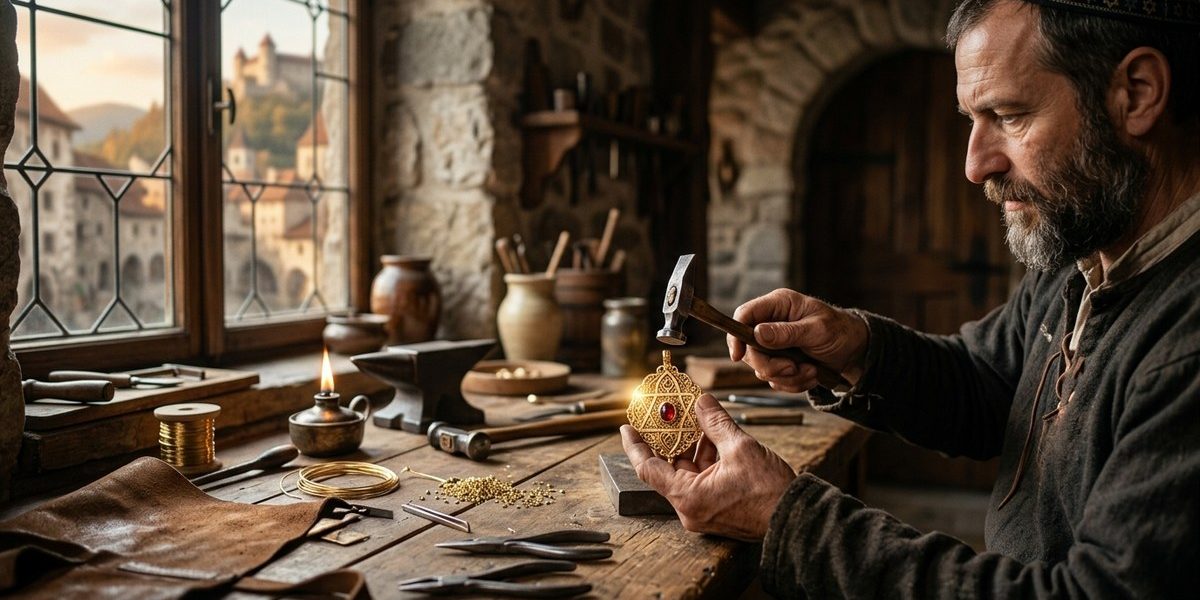
Imagine stepping into a workshop in Ptuj in the year 1380. The air is thick with the smell of charcoal and flux. A Jewish goldsmith sits at a low bench. He uses a small bellows to keep the coals hot. His tools are simple: hammers, files, and tweezers. But his hands are steady.
He is working on a silver chalice for a local abbot. The design includes grapevines and leaves, symbols of the Eucharist. But if you look closely, you might see a small star of David hidden in the pattern. This was a quiet signature. A way for the artist to mark his work without drawing attention.
The process was slow. First, the silver had to be melted and poured into an ingot. Then it was hammered into a thin sheet. The design was sketched in charcoal. Then the real work began. Hours of hammering, filing, and polishing. A single chalice could take months to complete.
What We Can Learn Today
The story of medieval Jewish goldsmiths in Slovenia is a reminder that history is not a single story. It is a tapestry of many threads. For too long, the Jewish contribution to Slovenian culture has been minimized. But the evidence is there, in the metalwork that survives.
If you are a researcher or a student of art history, consider this your starting point. Look at the objects closely. Notice the details. Ask who made them and under what conditions. The answers might surprise you.
You can also explore how Jewish ceremonial objects reflect centuries of artistic mastery. And if you are interested in the broader economic impact, read about how Jewish traders shaped Slovenia’s medieval economy.
Preserving a Fragile Heritage
Many of these objects are in poor condition. Centuries of use, neglect, and even deliberate destruction have taken their toll. Some have been melted down for their metal. Others have lost their original context.
Conservation efforts are underway. Museums are working to identify pieces that may have Jewish origins. New research is being published. But there is still much to do.
If you want to support this work, consider visiting the museums that hold these collections. Talk to the curators. Share what you learn. Every conversation helps keep this history alive.
For a more personal connection, read about how to trace your Slovenian Jewish ancestry in 2026. And for a look at the broader artistic landscape, see how Jewish calligraphy and illuminated manuscripts offer a window into centuries of devotion.
A Legacy of Light and Metal
The work of medieval Jewish goldsmiths in Slovenia is a legacy of light and metal. They turned raw materials into objects of meaning. They bridged cultures. They left a mark that time has not erased.
The next time you see a piece of medieval silver in a Slovenian museum, take a moment. Think about the hands that made it. Think about the world they lived in. And remember that their story is part of your story too.
Go see these pieces for yourself. Touch the history. And let it inspire you to look deeper.