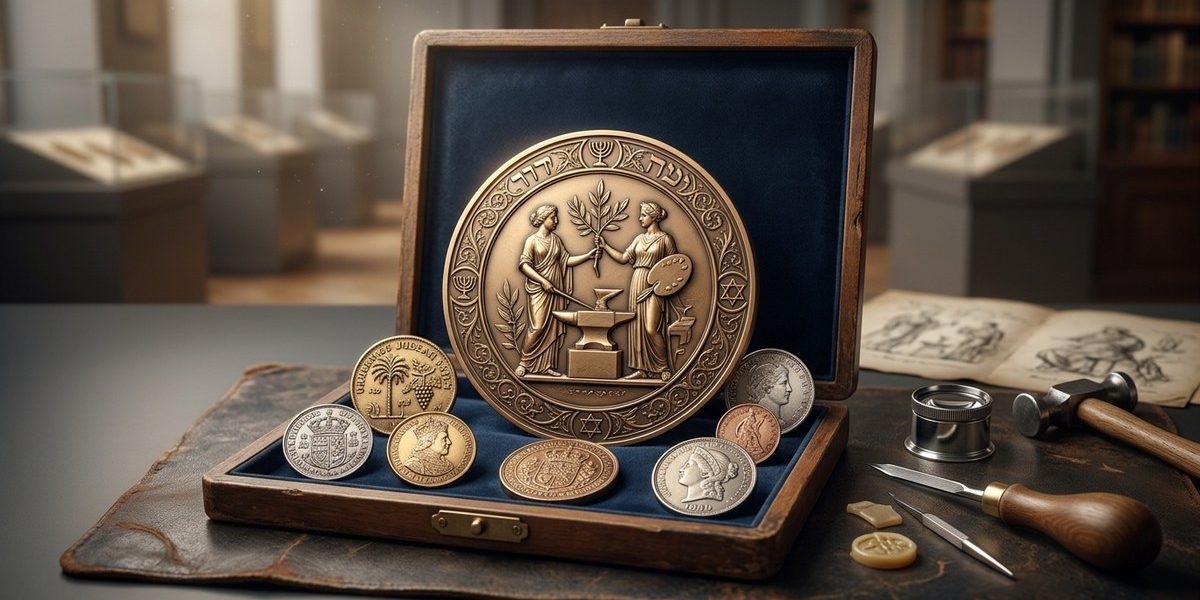
You might hold a coin every day without thinking about who carved its design. But some of the most beautiful coins ever minted were made by Jewish engravers and medalists. These artists worked in royal mints across Europe, creating currency that outlasted empires. Their story is a hidden thread in the fabric of numismatic history.
Jewish coin engravers history reveals a legacy of artistic mastery and cultural resilience. From Renaissance medalists to modern mint masters, Jewish artisans shaped the look of currency across Europe. Their work combined technical skill with deep symbolic meaning. This article uncovers who they were, why their art mattered, and how their influence still shows up in coins we collect and admire today.
The Hidden Role of Jewish Artists in European Mints
For centuries, Jewish engravers worked at the highest levels of European coin production. They were not just laborers. They were master artisans who understood metallurgy, design, and the political messaging that coins carried. A king’s portrait on a coin was a statement of power. Jewish engravers helped craft those statements.
Why did so many Jewish artists end up in this trade? Part of the answer lies in historical restrictions. In many parts of Europe, Jews were barred from owning land or joining most guilds. But skills like metalworking, engraving, and die cutting were often permitted. Jewish families passed these crafts down through generations. A father taught his son how to hold a graver, how to read a die, how to strike a perfect medal.
This created a pipeline of talent that royal mints depended on. When a ruler needed a new coinage system, they often turned to Jewish engravers who had the technical skill and the artistic vision.
Who Were the Most Famous Jewish Coin Engravers?
Let us look at a few names that every collector should know.
Benedetto Pistrucci (1783-1855)
Pistrucci is one of the most famous coin engravers in British history. He designed the Saint George and the Dragon reverse that still appears on British sovereigns today. What many people do not realize is that Pistrucci was born into a Jewish family in Rome. His father was a judge in the Jewish community there.
Pistrucci moved to England and became the chief medallist at the Royal Mint. His work set a standard for coin design that lasted for generations. The sovereign design he created in 1817 is still minted in 2026. That is over two centuries of continuous use.
The Wiener Family of Medallists
The Wiener family produced several generations of Jewish engravers across Europe. Jacques Wiener (1815-1899) was a Belgian Jewish medallist who created some of the most detailed coin and medal designs of the 19th century. His brothers Leopold and Charles also worked as engravers.
The Wiener brothers are known for their series of medals depicting European cathedrals. These pieces are highly sought after by collectors today. The level of detail in their work is staggering. They managed to capture the stone carvings of Gothic cathedrals on small metal discs.
Moritz Furst (1782-1841)
Furst was a Jewish medalist from Hungary who worked for the United States Mint. He designed many early American medals, including the Indian Peace Medals given to Native American leaders. Furst brought European techniques to American coinage. His work helped shape the visual identity of the young republic.
The Galle Family of Frankfurt
The Galle family were Jewish engravers who worked for the Frankfurt Mint in the 18th and 19th centuries. They produced coins for multiple German states. Their work shows the transition from hand engraving to machine assisted die production. The Galle family archive contains thousands of designs that tell the story of German numismatics.
The Techniques These Masters Used
Jewish coin engravers history is also a story of technical innovation. Here is a numbered list of the key techniques these artisans mastered:
- Die striking: The engraver carved a design into a steel die. This die was then used to strike coins under pressure. Getting the depth and relief right required years of practice.
- Reduction pantography: In the 19th century, engravers used a pantograph machine to reduce large plaster models into small coin dies. Jewish engravers like Jacques Wiener were early adopters of this technology.
- Hand chasing: After striking, some coins needed hand finishing. Engravers would sharpen details with small chisels and gravers. This step separated good coins from great ones.
- Medal turning: For large medals, engravers used a specialized lathe to carve designs directly into steel. This required an understanding of both art and engineering.
- Galvanoplasty: Jewish engravers also used electrotyping to create reproduction dies. This allowed them to preserve original designs while making working copies.
What Made Jewish Engravers Different?
Jewish engravers brought a unique perspective to their work. Many of them were deeply connected to Jewish textual traditions. The precision required for writing Torah scrolls translated directly to the precision needed for engraving letters on coins.
They also understood symbolism in a way that other engravers sometimes missed. A Jewish engraver might include subtle references to Hebrew letters or Jewish motifs in his designs. These details are invisible to most people but meaningful to those who know where to look.
Here are some characteristics that set Jewish engravers apart:
- They often worked across national borders, bringing techniques from one country to another
- They maintained strong family networks that functioned like informal trade schools
- They adapted to new technologies faster than many guild based engravers
- They created designs that balanced artistic beauty with the practical needs of mass production
A Table of Techniques and Common Mistakes
| Technique | What It Involves | Mistake to Avoid |
|---|---|---|
| Die engraving | Cutting design into steel with hand tools | Cutting too deep, which weakens the die |
| Relief modeling | Building up the design in plaster first | Making the relief too high for striking |
| Letter cutting | Carving text backwards so it reads correctly on the coin | Getting the letter orientation wrong |
| Edge lettering | Adding text to the coin edge using a segmented collar | Misaligning the letters so they overlap |
| Proof finishing | Polishing the die to create mirror like fields | Over polishing and losing fine detail |
Why Jewish Engravers Were Trusted with National Currency
Rulers trusted Jewish engravers with their most important symbols. A coin is more than money. It is a statement of sovereignty. When a king put his face on a coin, he was saying “I rule here.” Trusting that task to a Jewish artist meant that the ruler respected the artist’s skill above religious or ethnic prejudice.
This trust was not always consistent. Jewish engravers faced periods of persecution and expulsion. But their skills were so valuable that rulers often brought them back. The history of Jewish coin engravers is a story of talent overcoming bigotry.
“The art of the medal is the art of permanence. A good medal outlasts the ruler who commissioned it, the language spoken around it, and the religion of its maker. It becomes a piece of history that anyone can hold.” – Adapted from the writings of Jacques Wiener
The Decline and Revival of Jewish Coin Engraving
The 20th century saw a decline in traditional coin engraving. Machine production replaced hand work. Many Jewish engraving families were lost in the Holocaust. The Wiener family line was broken. Entire workshops disappeared.
But the tradition did not die completely. In recent decades, there has been a revival of interest in hand engraved coins and medals. Modern Jewish engravers are rediscovering the techniques of their ancestors. The Israel Coins and Medals Corporation employs skilled engravers who continue the tradition.
Collectors now seek out works by Jewish engravers. A medal by Benedetto Pistrucci can sell for thousands of dollars at auction. The market for Wiener family medals has grown steadily. This demand helps preserve the knowledge of how these pieces were made.
How to Identify Jewish Engraver Coins in Your Collection
If you have a collection of coins or medals, you might already own work by a Jewish engraver. Here is how to check:
Look at the edge or the base of the design for a signature. Pistrucci often signed with his full name or initials. The Wiener brothers used “J. WIENER” or “L. WIENER.” Many Jewish engravers signed their work in Hebrew letters as well as Latin ones.
Check the date and place of minting. Coins from London, Vienna, Frankfurt, and Brussels in the 18th and 19th centuries are good candidates. Research the mint master for that period. Many mints employed Jewish engravers as their chief designers.
Consult reference books on Jewish medalists. There are specialized catalogs that list known works by Jewish engravers. The Jewish Museum in London has a collection of medals by Jewish artists.
The Connection to Broader Jewish Artistic Heritage
Jewish coin engravers were part of a larger tradition of Jewish artistry. They worked alongside Jewish painters, sculptors, and metalworkers. The skills they developed were the same skills used to create ceremonial objects like menorahs, Torah shields, and spice boxes.
If you are interested in how Jewish artists shaped other fields, you might enjoy reading about how Jewish artists shaped modern art movements in Central Europe. The same creative energy that produced great coins also produced great paintings and sculptures.
Why This History Matters for Collectors Today
Understanding Jewish coin engravers history adds depth to any collection. A coin is not just a piece of metal. It is a document of human skill and cultural exchange. When you hold a coin engraved by a Jewish artist, you are holding the work of someone who overcame barriers to create something beautiful.
For Jewish collectors, there is an additional layer of meaning. These coins represent Jewish achievement in a field where Jewish contributions are often overlooked. They are proof that Jewish artisans were central to European culture, not marginal to it.
For all collectors, the story of Jewish engravers is a reminder that great art comes from unexpected places. The next time you look at a coin, take a moment to think about the hands that carved it. They might have belonged to a Jewish engraver whose name is waiting to be remembered.
Honoring the Legacy of Jewish Medalists
The best way to honor these artists is to learn their names and share their stories. When you show your collection to friends, mention the engraver. Tell them about Pistrucci and the Wiener brothers. Help keep their memory alive.
You can also support museums and institutions that preserve Jewish numismatic heritage. The American Numismatic Society has resources on Jewish engravers. The Jewish Historical Society in your area might have exhibits on Jewish artisans.
Consider adding a piece by a known Jewish engraver to your collection. Even a common coin with a signature can be a starting point. As you learn more, you will start to recognize the hand of these masters in coins you might have overlooked before.
The story of Jewish coin engravers is not finished. New discoveries are made every year. Old dies are found in archives. Unattributed medals are matched to their creators. This is a living field of study, and you can be part of it.