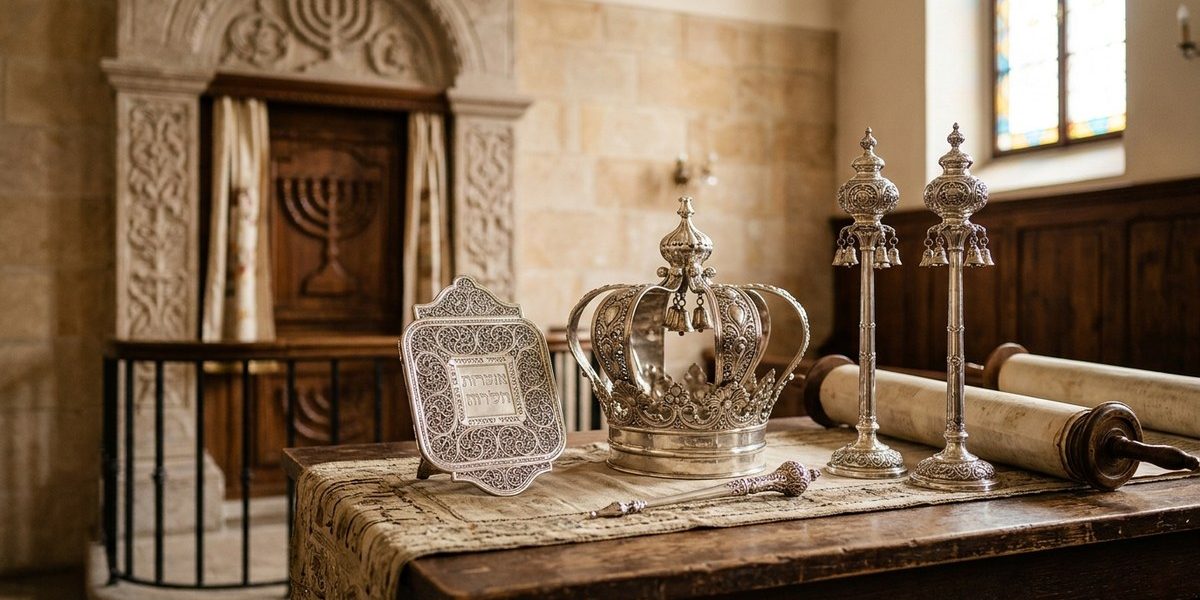
Walk into a historic European synagogue, and your eye might first go to the ark or the stained glass. But look closer at the ritual objects. The Torah finials catching the light. The silver pointer used for reading. The spice towers that gleam on Saturday afternoons. For centuries, these pieces of Jewish ceremonial silver were not just functional tools. They were the heart of the visual experience in the sanctuary, defining the aesthetic of European synagogues more than any other decorative element.
Jewish ceremonial silver objects like Torah crowns, finials, and spice boxes were central to the visual and spiritual identity of European synagogues from the 16th to early 20th centuries. They reflected local artistic trends, Jewish patronage, and communal pride, making them a unique fusion of faith and craftsmanship that defined the synagogue interior.
The Brilliance of Silver in Sacred Spaces
Silver has always held a special place in Jewish tradition. It is a metal that shines without being ostentatious. It does not tarnish easily when cared for, and its reflective surface reminds the congregation of the divine light of the Torah. Unlike gold, which was often reserved for royalty or the very wealthy, silver was accessible to communities of modest means. This made it the perfect material for objects that needed to be both beautiful and practical.
In European synagogues, especially those in Poland, Germany, Austria, and the Czech lands, silver objects were often the most expensive items in the building. A Torah crown made of silver could cost as much as a small house. Communities saved for years to commission a single piece. They did this because the beauty of the ritual object was seen as a form of honor, a way to elevate the sacred text and the service itself.
Key Objects That Shaped the Aesthetic
The most visible pieces of Jewish ceremonial silver in a synagogue typically included:
- Torah crowns (Keter Torah) : Placed on top of the Torah scroll, often decorated with bells and filigree.
- Rimonim (Torah finials) : Pairs of silver ornaments that fit over the wooden rollers of the Torah. They are often shaped like towers or pomegranates.
- Yad (Torah pointer) : A long silver rod with a small hand at the end, used to follow the text without touching the parchment.
- Spice boxes (B’samim) : Used during the Havdalah ceremony at the end of Shabbat. They came in many shapes, from towers to fruits to animals.
- Hanukkah lamps : Many were made of silver, especially in wealthy communities.
- Eternal light (Ner Tamid) : The lamp hanging above the ark was sometimes made of silver or silver-plated.
Each of these objects contributed to a cohesive visual language. When you stood in the synagogue and looked toward the ark, you saw a symphony of silver forms. The light from candles or oil lamps would dance across the polished surfaces, creating a sense of warmth and holiness.
How the Patronage System Worked
Jewish communities in Europe did not have royal patrons in the same way that Christian cathedrals did. Instead, the synagogue’s silver was funded by individual families, guilds, or burial societies. A wealthy merchant might donate a pair of finials in memory of a parent. A women’s group might pool funds for a new Torah crown. This practice created a deep connection between the object and the community.
The names of donors were often engraved on the base of the object. This was not just about credit. It was a way to ensure that the family would be remembered and blessed during the Torah reading. Some objects from the 17th and 18th centuries carry long inscriptions that read like mini biographies of the donor.
“The silver objects in a synagogue were not just decorations. They were a ledger of communal memory. Every finial, every crown, every pointer told the story of a family who wanted their name linked to the holiness of the Torah.” Dr. Rachel Stern, Judaica historian.
The Role of Local Goldsmiths
Jewish silversmiths were active in many European cities, but they were not the only ones making synagogue silver. In some places, Christian goldsmiths took commissions from Jewish communities. This led to a fascinating blend of styles. A Torah crown made in 18th century Vienna might show the influence of Baroque design, with swirling leaves and cherub-like forms. A spice box from Poland might look like a small tower, reflecting the local architecture.
The relationship between Jewish patrons and local craftsmen was a two-way street. Jewish ceremonial silver often incorporated motifs that were meaningful to Jewish tradition, such as the Tablets of the Law, the Star of David, or the seven-branched menorah. But the execution of these motifs followed the artistic trends of the region. This is why you can look at a silver object and often guess which country it came from, even if you know nothing about the maker.
A Numbered Process: How a Silver Object Was Commissioned
The creation of a major piece of Jewish ceremonial silver followed a clear process. Here is how it typically worked:
- A family or group identifies a need. Maybe the synagogue needs a new Torah crown, or a family wants to donate a pair of finials for a yahrzeit (anniversary of a death).
- The donor approaches the synagogue board. The board approves the design and sets a budget. Sometimes they have a specific silversmith in mind.
- The silversmith creates a wax model. This model is shown to the donor and the board for approval. The design must be both beautiful and functional, since the object will be handled during services.
- The object is cast, chased, and engraved. The silversmith uses techniques like repoussé (hammering from the back) and chasing (refining from the front) to create the final piece. Inscriptions are added.
- The object is dedicated during a ceremony. Often this happens on a holiday or Shabbat. The community celebrates, and the donor is honored with an aliyah (being called to the Torah).
Why Silver Defined the Synagogue Interior
The dominance of silver in European synagogues was not accidental. Several factors came together to make it the defining material.
| Factor | Why It Mattered |
|---|---|
| Affordable prestige | Silver was cheaper than gold but still valuable. A community could afford a beautiful silver object without bankrupting itself. |
| Symbolic purity | Silver was associated with purity and light. It did not rust or corrode easily, making it a fitting material for holy objects. |
| Craftsmanship available | Many cities had skilled silversmiths who could take commissions. Jewish and non-Jewish craftsmen both produced high quality work. |
| Durability | Unlike textiles or wood, silver objects could last for centuries with proper care. Many pieces from the 1700s survive today. |
| Visual impact | The reflective surface of silver caught candlelight and made the ark area glow. This created a focal point for the congregation. |
The Decline of the Silver Aesthetic
By the late 19th century, the role of silver in synagogues began to change. Industrialization made silver plate and cheaper metals more common. Synagogues built in the modern style often favored simpler designs. The Holocaust then destroyed many of the great European Jewish communities, along with their silver treasures. Some pieces were looted. Others were melted down for bullion.
Today, the surviving pieces of Jewish ceremonial silver are scattered across museums and private collections. They serve as a powerful reminder of what was lost, but also of the creativity and devotion that once filled every synagogue in Europe. If you want to see some of the finest examples, you can visit the Jewish Museum in Berlin, the Israel Museum in Jerusalem, or the Jewish Historical Museum in Amsterdam. Each object tells a story about the community that made it and the people who used it.
How to Identify Authentic Jewish Ceremonial Silver
For collectors and art historians, knowing what to look for is essential. Here are some tips:
- Check for hallmarks. Many silver objects from Europe have a maker’s mark, a town mark, and a date letter. These can help you identify the origin and age.
- Look at the style. A Torah finial from 17th century Poland will look very different from one made in 19th century Vienna. Learn the regional styles.
- Examine the inscriptions. Hebrew inscriptions often include the name of the donor, the date, and a blessing. They can provide a wealth of information.
- Consider the condition. Silver can be bent, dented, or repaired. Minor damage does not always reduce value, but major restorations can.
The Legacy Lives On
Jewish ceremonial silver once defined the aesthetic of European synagogues, but its influence did not end there. Today, contemporary Jewish artists are creating new silver objects for synagogues around the world. They draw on the same traditions of craftsmanship and symbolism, but they add modern touches. The result is a living art form that connects the past to the present.
If you are interested in learning more about how Jewish artists shaped visual culture in Europe, you might enjoy reading about how Jewish artists shaped modern art movements in Central Europe. For a look at how these ceremonial objects fit into the broader story of Jewish craftsmanship, our article on how Jewish ceremonial objects reflect centuries of artistic mastery offers a deeper perspective.
The Future of Silver in Jewish Tradition
The story of Jewish ceremonial silver is not just a story of the past. It is a reminder that beauty and faith can work together. When a community invests in a beautiful object for its synagogue, it is making a statement about what it values. It is saying that the sacred deserves the best. That idea is just as powerful today as it was in 17th century Krakow or 19th century Vienna.
Next time you step into a synagogue, take a moment to look at the silver. Notice the way it catches the light. Think about the hands that made it and the community that paid for it. That piece of metal holds centuries of memory, devotion, and artistry. It is a small window into a world that once was, and a reminder of what we can still create when we put our hearts into our traditions.